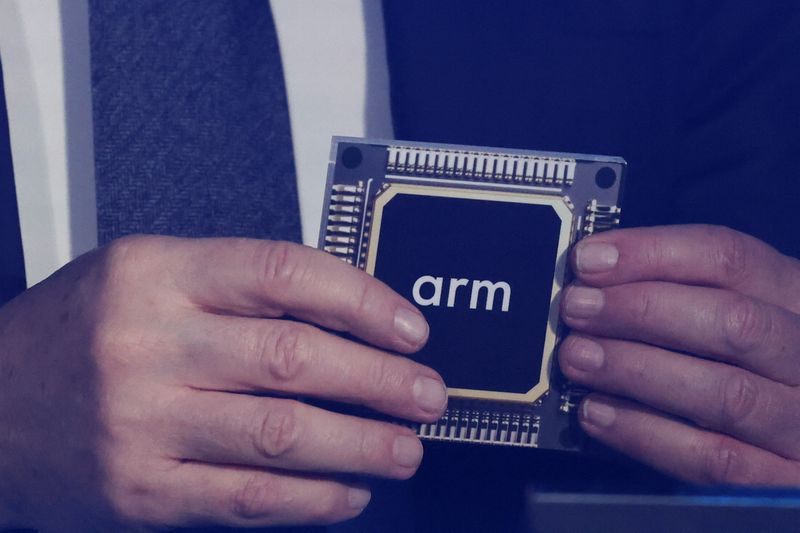
UBS says agentic AI could expand the server CPU TAM nearly 5x to $170 billion by 2030 from $30 billion in 2025, driven by a jump in CPU demand per GPU from 8-12 cores to 80-120 cores. ARM is expected to capture a larger share of this growth, with unit share rising to 40%-45% by 2030 and UBS lifting its price target to $245 from $175. UBS also projects 2030 pro forma CPU revenues of about $41 billion for AMD, $39 billion for Intel, and $26 billion for ARM.
The market is still underestimating how aggressively agentic AI shifts value from accelerators to orchestration layers. The important second-order effect is not just more CPUs per GPU, but a broader re-rating of the entire server stack toward high-core-count, high-efficiency control planes that sit closest to scheduling, memory management, and inference routing. That favors architectures optimized for power density and software-defined deployment economics, not raw FLOPS, which is why the opportunity set broadens beyond the obvious accelerator winners.
ARM looks like the cleanest structural beneficiary because its upside is leverage to both hyperscale and edge adoption. If the workload mix migrates toward localized inference and device-side orchestration, ARM can gain twice: higher server share in cloud head nodes and more content in PCs and endpoints pulled into the agentic refresh cycle. The hidden risk is that the market may be paying too much for the end-state too early; the adoption curve is likely lumpy, with procurement cycles and software readiness delaying the revenue inflection until late-2026 to 2028.
AMD’s setup is attractive on relative share gains in dense multi-threaded workloads, but the more interesting trade is that this is a CPU attach-rate story, not a pure share story. If attach ratios move toward 1:1 with accelerators, vendor mix matters less than package economics, meaning winners will be those who can bundle CPU, memory, networking, and software at scale. Intel’s path is more asymmetric: near-term upside is less about regaining datacenter leadership and more about PC replacement demand if agents run locally, making it a slower-burn, higher-execution-risk turnaround.
The contrarian view is that consensus may be extrapolating agentic complexity faster than real enterprise deployment supports. Many early agent workflows will remain throttled by governance, security, and latency concerns, which could keep core counts and ASPs elevated in pilot programs but below model assumptions in mass rollout. That creates a favorable setup for tactical positioning, but the durability of the 2030 revenue curve should be treated as conditional on software standardization and inference cost compression not outrunning demand growth.
AI-powered research, real-time alerts, and portfolio analytics for institutional investors.
Request DemoOverall Sentiment
moderately positive
Sentiment Score
0.58
Ticker Sentiment
