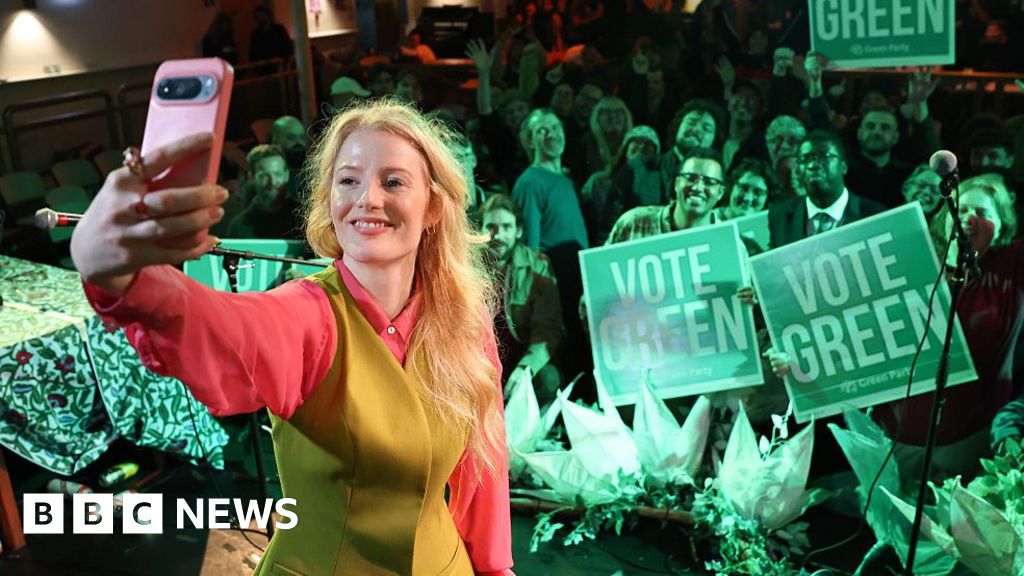
The Green Party captured the Gorton and Denton seat in a shock by-election win as Hannah Spencer took 14,980 votes (≈41%) with a majority of more than 4,000 and a 26.4% swing from Labour; Reform UK placed second on 10,578 and Labour fell to third with 9,364. The result — triggered by the resignation of Labour MP Andrew Gwynne — is a significant symbolic blow to Labour ahead of May elections, intensifying leadership pressure and prompting concerns about voter volatility and election integrity after an observer group reported widespread ‘family voting’. The outcome is politically notable but has limited direct market implications, instead serving as a signal of heightened domestic political uncertainty that could influence investor sentiment ahead of larger national contests.
Market structure: The Greens’ by-election win is a political volatility shock concentrated in UK domestic politics — immediate beneficiaries are small-cap renewable/green-service providers and local-level contractors who can claim policy tailwinds; losers are incumbency-sensitive assets (Labour-linked names, UK housebuilders, and politically-exposed financials). Pricing-power shifts are asymmetric: policy uncertainty raises risk premia on UK equities and the pound (GBP) by ~0.2–0.7% near-term while selectively boosting expected long-term subsidy flows into clean-energy capex.
Risk assessment: Tail risks include a leftward Labour policy pivot (higher windfall/corporate taxes, stricter planning) that could shave 5–15% off valuations of UK banks, housebuilders and energy majors in a downside scenario; low-probability, high-impact revolt against Starmer could increase market volatility into May elections. Time horizons: days–weeks for GBP/gilt moves, weeks–months for sector rotation, and quarters for fiscal/regulatory re-pricing. Hidden dependencies include local turnout dynamics (family voting claims) that could reverse political signals and thereby reverse market moves.
Trade implications: Tactical plays should favor selective long renewable/utility exposure (National Grid NG.L, SSE.L, or ICLN ETF) and defensive consumer names, paired with short positions in UK housebuilders (BDEV.L, PSN.L) and trimmed exposure to major UK banks (HSBA.L, BARC.L). Cross-asset trades: short modest gilt duration (if 10y yields breach +15bp) and buy 1–3 month GBP puts to hedge currency risk; options used to cap cost and express asymmetric views.
Contrarian angles: The market may overstate the durability of a single by-election; historically (post-2010/2017) by-election shocks reverted after national votes, creating buying opportunities in cyclicals if Labour consolidates policy clarity. Consensus misses the possibility that a pragmatic Labour response (moderate spending promises) could reduce uncertainty and produce a sharp relief rally in UK equities — wait for May local results before scaling long UK cyclicals beyond 2–3% of NAV.
AI-powered research, real-time alerts, and portfolio analytics for institutional investors.
Request DemoOverall Sentiment
mixed
Sentiment Score
-0.10
