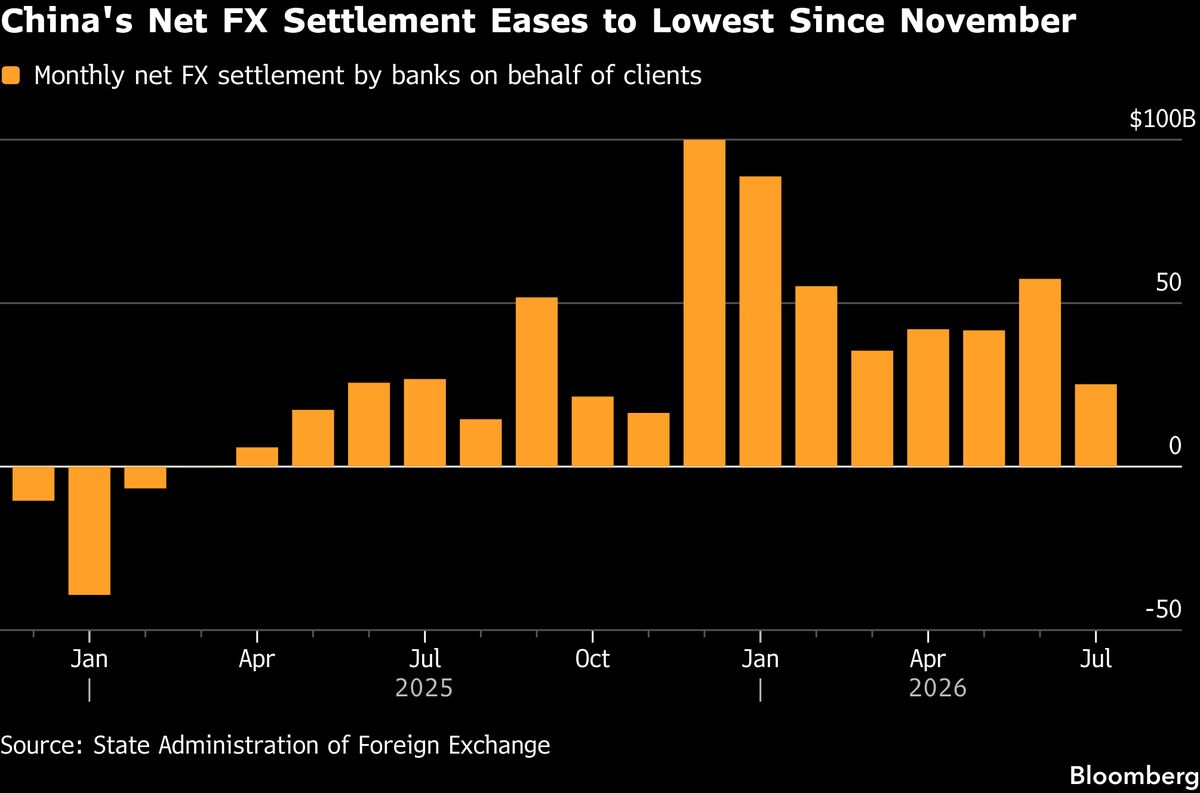
Chinese banks’ net FX sales for clients more than halved from June to $25.2B in July, the lowest since Nov 2025, indicating weaker offshore/onshore support for the yuan. The move drove net FX sales by Chinese companies to an eight-month low, suggesting a key yuan-support channel may be fading. This is a moderate headwind for FX sentiment, potentially increasing USD/CNY volatility.
This is more important as a signal on corporate behavior than as a one-day FX print. When firms stop converting dollars into yuan, the market loses a built-in stabilizer; that usually shows up first in offshore CNH basis and forward points before spot breaks. The second-order winner is the dollar: a slower conversion cycle tends to support UUP and any hedge that benefits from a richer USD funding premium.
The bigger medium-term implication is equity multiple pressure, not just FX direction. A softer yuan raises imported input costs for China’s commodity-heavy manufacturers and can force more policy easing to cushion growth, which is typically negative for FXI/MCHI and for Asia ex-Japan currencies that trade as China proxies. At the same time, Chinese exporters that keep more of their receipts in USD gain balance-sheet optionality, while domestic importers and USD borrowers face margin squeeze if the currency trend persists.
Contrarian risk: this may be treasury timing, not conviction. If the PBOC keeps setting the fix stronger than the street expects and trade-surplus inflows remain intact, this signal can reverse quickly. The thesis is falsified if USD/CNH cannot sustain upward pressure over the next 2-4 weeks or if daily fixing bias reasserts a clear appreciation signal; beyond that, the real catalyst is whether hedging demand starts to climb, which would confirm a self-reinforcing devaluation narrative.
AI-powered research, real-time alerts, and portfolio analytics for institutional investors.
Request DemoOverall Sentiment
mildly negative
Sentiment Score
-0.25
