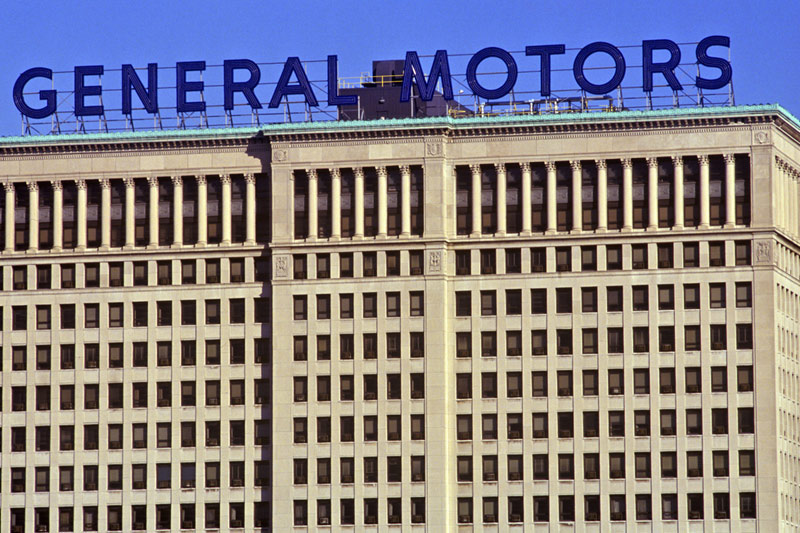
General Motors beat Q1 expectations across key metrics, reporting adjusted EBIT of $4.3 billion and a 9.7% margin versus $3.0 billion expected, then raised full-year adjusted EBIT guidance to $13.5-15.5 billion from $13.0-15.0 billion. The guidance increase is entirely driven by an estimated $500 million tariff-related benefit tied to a U.S. Supreme Court IEEPA ruling, while GM kept automotive free cash flow guidance at $9.0-11.0 billion and noted higher commodity/freight cost headwinds of $1.5-2.0 billion. GM also repurchased $800 million of stock in the quarter, with $5.5 billion remaining on authorization, though shares still fell 1.49% on the day.
The key signal is not the headline beat; it is that GM is using a one-time tariff/legal benefit to mask a still-tight underlying auto margin environment. That matters because the market will quickly re-rate the durability of the guidance raise once investors normalize out the refund, leaving the stock exposed if commodity, freight, or incentive pressure persists into 2H. In other words, the next 1-2 quarters are about proving that core North America EBIT can hold up without accounting help.
The second-order winner is GM's supply chain discipline: if management is already flagging higher commodity and freight costs yet still preserving FCF, downstream suppliers with weak bargaining power are likely absorbing the squeeze. That typically favors the OEM over Tier 1s in the near term, but it also implies pricing power is finite, and any slowdown in unit demand would force GM to choose between mix, incentives, or margin. Competitively, legacy OEMs with less North America exposure are more vulnerable if this cost inflation persists, while EV-heavy peers with weaker profitability profiles face even less room to absorb a macro wobble.
The contrarian read is that the stock's muted reaction may actually be a tell: investors are skeptical of earnings quality, but that skepticism can create a favorable setup if the company converts the legal windfall into buybacks before the market fully prices it in. The risk is timing — the cash refund uncertainty can push the narrative into months, not days, and if the tariff benefit lands late, the incremental capital return may be perceived as defensive rather than value-creative. A clean upside catalyst would be a second consecutive quarter of core EBIT strength excluding legal/tariff items, which would convert this from a one-off story into a sustained margin reset.
AI-powered research, real-time alerts, and portfolio analytics for institutional investors.
Request DemoOverall Sentiment
moderately positive
Sentiment Score
0.62
Ticker Sentiment
