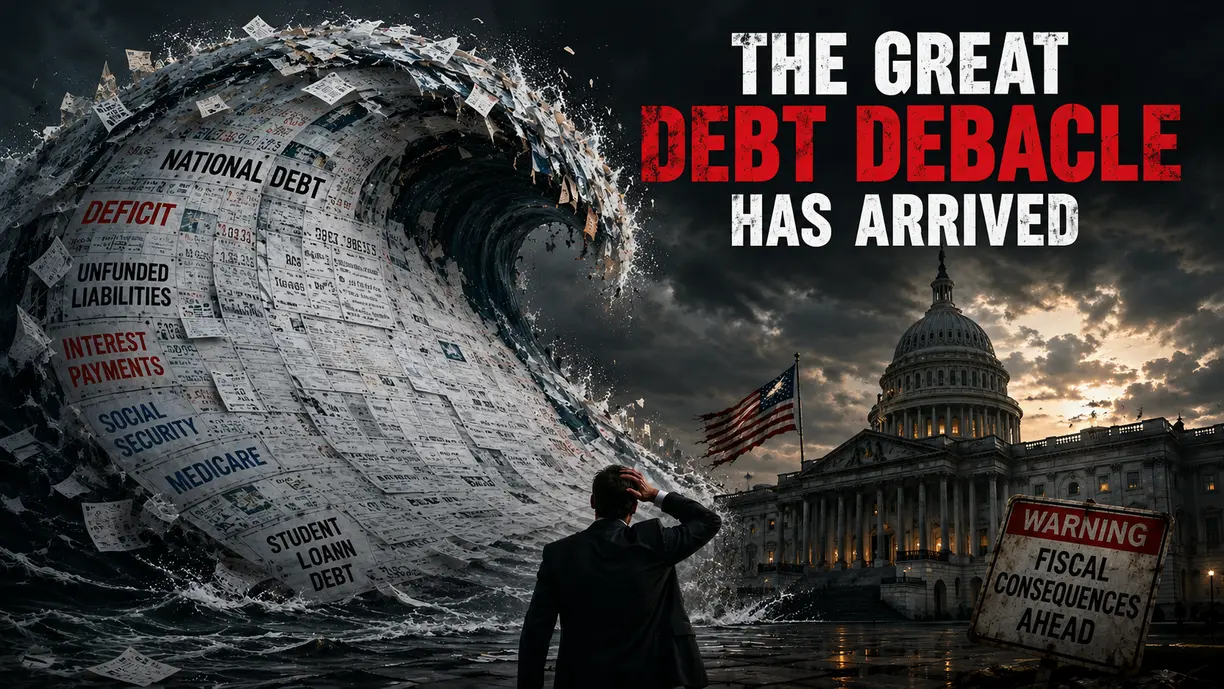
The article warns that U.S. debt has doubled over the past decade and now stands near $180 trillion when including unfunded liabilities, versus GDP of about $32 trillion. It argues that rising interest rates are a major threat, with a 1% rate increase implying roughly $1 trillion in additional annual interest expense, while higher global sovereign yields remove support for Treasuries. The piece frames a shrinking Fed balance sheet under Kevin Warsh as hawkish, with tighter liquidity likely to pressure asset prices and real returns.
The market is not pricing the second-order consequence of a sustained reserve drain: liquidity-sensitive assets tend to reprice before the macro data visibly rolls over. The early winners are not “quality” equities but duration-sensitive cash instruments and balance-sheet fortresses that can harvest wider spreads while funding costs rise more slowly than asset yields. The losers are levered financial intermediaries, lower-quality credit, and any equity story that depends on persistent multiple expansion rather than earnings power.
The most important transmission mechanism is not default, but convexity: higher real rates tighten collateral values, reduce repo capacity, and force de-risking across structured credit, private credit, and marginal equity holders. That can create a reflexive loop where lower asset prices feed tighter financial conditions, which in turn strengthens the case for policy reversal. The timeline is likely months, not days, unless there is a disorderly move in long-end yields or funding markets.
The contrarian risk is that the market may be overestimating how quickly a balance-sheet runoff turns into a systemic event. If inflation stays sticky, the Fed can tolerate more pain than consensus expects, especially while labor data remains firm. That argues for using optionality rather than outright beta shorts: the asymmetry is best expressed through rate-sensitive losers and volatility rather than a broad equity market crash thesis.
A separate second-order effect is relative global bond competition. If foreign sovereign yields keep backing up, U.S. duration may remain less unattractive on a hedged basis, limiting the pace of Treasury selloff even amid fiscal stress. In that scenario, the real trade is not a collapse in Treasuries, but a widening dispersion between funded and unfunded balance sheets, with weak issuers punished hardest and the sovereign still treated as the least-bad collateral asset.
AI-powered research, real-time alerts, and portfolio analytics for institutional investors.
Request TrialOverall Sentiment
strongly negative
Sentiment Score
-0.78
