


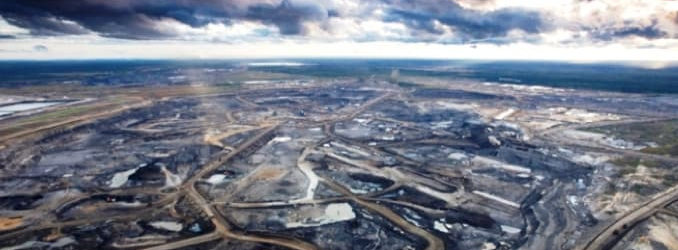
Wildfires in Alberta are threatening roughly 500,000 barrels a day of oil production within 20 kilometers of active blazes, including major sites such as Cenovus’s Christina Lake and ConocoPhillips’ Surmont. Six out-of-control fires are burning in the Lac la Biche region, and about 229 residents of Conklin have been told to prepare to evacuate. The fire risk comes as global oil markets are already tight, with Middle East curtailments supporting crude prices above $100 a barrel at times over the past three months.
The immediate market issue is not a blanket supply shock but a convexity problem: a small probability of meaningful Canadian disruption layered on top of an already tight global marginal barrel. That matters because Alberta heavy crude is difficult to replace quickly, so even limited outages can widen heavy-light differentials and lift realized pricing for unaffected North American barrels. The first beneficiaries are peers with cleaner access to crude pricing and lower wildfire exposure; the hurt is concentrated in names with the largest in-situ footprint near the fire corridor and in refiners that depend on discounted Canadian feedstock.
The second-order effect is on volatility rather than spot price direction. If the fires remain nearby but do not trigger shutdowns, the market can fade the headline quickly; if a single major operator pulls production for safety, the reaction can be abrupt because traders will extrapolate from a low-visibility asset base with limited real-time data. This is especially relevant for the next 1-3 weeks, when fire containment headlines will dominate, versus the next 1-3 months, when lost production could show up in guidance cuts and Q3 differentials.
The bigger macro overlay is that the market is already paying a geopolitical risk premium in oil, so any incremental Canadian outage has a higher-than-normal price impact. That said, the consensus may be overstating the probability of a structural supply loss: most wildfire risk is operationally manageable unless winds, evacuation orders, or utility interruptions force shut-ins. If weather improves, the premium should bleed out fast, making this more attractive as a tactical volatility trade than a directional crude bet.
The contrarian read is that the best expression may be in spread trades, not outright longs on oil. Heavy-crude-linked assets can outperform while broad energy beta barely moves, and any overreaction in producers with no direct exposure to Alberta could create relative-value opportunities if the fires stay contained. The key is to respect the tail: 2016-style outcomes are rare, but if the fire front approaches infrastructure, the repricing can become discrete and violent.
AI-powered research, real-time alerts, and portfolio analytics for institutional investors.
Request TrialOverall Sentiment
mildly negative
Sentiment Score
-0.35
Ticker Sentiment
