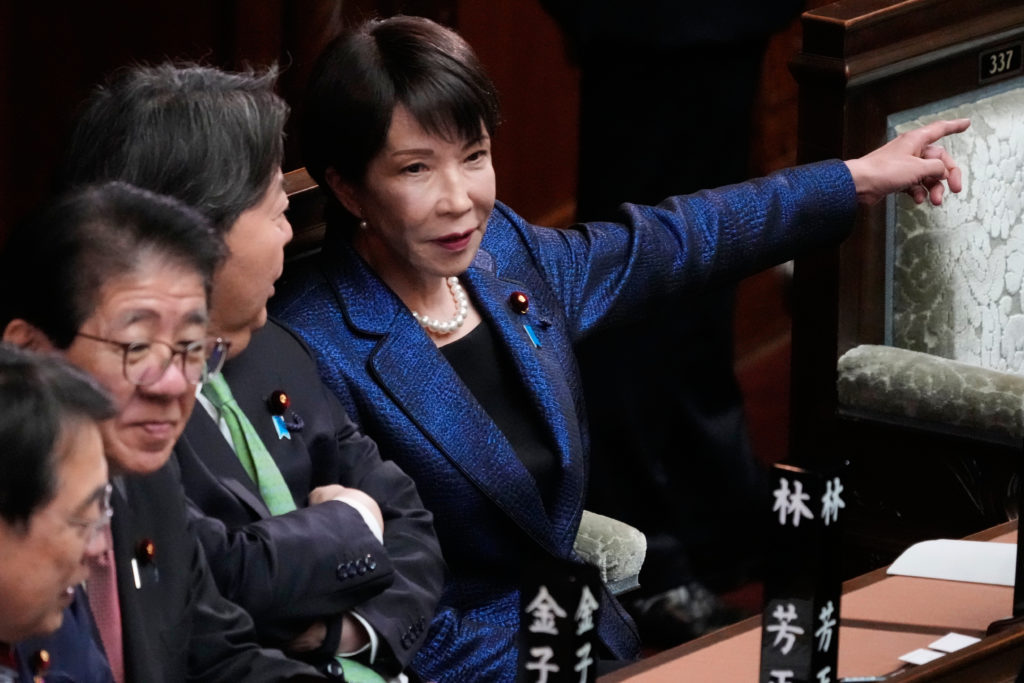
Sanae Takaichi was reappointed Japan’s prime minister after a landslide election and formed a new cabinet with a two-thirds lower-house supermajority; she is seeking closer U.S. cooperation on rare-earths development and economic security ahead of a March 19 summit and coordination on an initial $36 billion tranche of projects within a pledged $550 billion investment package (including an Ohio natural gas plant, a U.S. Gulf Coast crude export facility and a synthetic diamond site). Her agenda emphasizes higher defense spending, lifting limits on weapons exports, tougher immigration and anti-espionage measures, and a proposed two-year sales-tax cut on food to address rising prices — policies that raise fiscal and geopolitical tail risks investors should monitor for defense contractors, resource supply chains, energy assets and inflation expectations.
Market structure: Takaichi’s agenda (rare-earths cooperation with the U.S., higher defense spending, fiscal stimulus) structurally benefits rare-earth miners/processors, defense primes and domestic infrastructure suppliers while pressuring China-exposed exporters and export-dependent supply chains. Expect re‑rating of small/ mid‑cap rare‑earth plays and incremental order visibility for primes (LMT/RTX/NOC) within 6–18 months; short-term political friction could compress Japanese tourism/consumer services revenues by 5–15% if Beijing retaliates.
Risks & horizons: Immediate (days–weeks) FX and equity volatility around the March summit and Trump visits; short-term (1–6 months) headline-driven repricing of China-exposed assets; long-term (2–5 years) capex-led expansion of non‑Chinese rare-earth processing capacity but with 12–36 month project execution risk. Tail risks: kinetic escalation over Taiwan or broad Chinese economic reprisals that trigger 15–30% drawdowns in regional equities and 5–10% JPY moves. Hidden dependencies include Chinese control of downstream separation/refining and permitting timelines in US/Japan that can delay capacity by >24 months.
Trade implications: Tilt portfolios toward vertically integrated rare‑earth exposure and US defense primes while using relative shorts to hedge China cyclicals. Use option spreads to control cost: buy-dated call spreads on upstream rare-earth names for 6–12 month event exposure, and use interest-rate/fiscal hedges (short JGB futures or payer swaps) if Japanese 10‑yr yield breaches +30bp from current levels. Key catalysts: March 19 summit, Japan’s budget bill (next 1–3 months), Commerce Dept. capital allocations and any Chinese trade measures.
Contrarian angle: The market may overestimate near-term output from new rare‑earth projects; real non‑Chinese processing scale is likely 18–36 months away so premiums could compress before fundamentals improve. Conversely, consensus may underprice a sustained defense procurement wave—if Japan raises defense spending by 0.2–0.5% of GDP over 2 years, primes could see 10–25% incremental EPS upside. Watch for policy slippage (permitting, anti‑espionage backlash) that would delay gains and create entry points.
AI-powered research, real-time alerts, and portfolio analytics for institutional investors.
Request DemoOverall Sentiment
mixed
Sentiment Score
0.00
