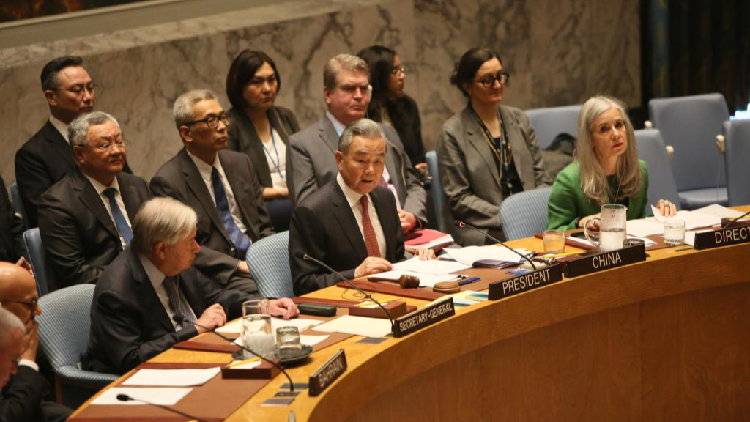
China highlighted its UN role, citing $23 billion in Global Development Initiative funding, more than 1,800 cooperation projects, up to 10,000 capacity-building programs, and over 200,000 professionals trained. Wang Yi also said China is ready to assist Ebola-response efforts in the Democratic Republic of the Congo and Uganda, and announced a global governance forum in Xiongan this autumn. The article is largely diplomatic and policy-oriented, with limited direct market impact.
This is less a market event than a signaling event: China is trying to monetize institutional legitimacy at a time when the U.S.-led architecture is being stress-tested. The investable read-through is not direct revenue but marginal re-rating for firms exposed to China’s state-backed external diplomacy stack — especially contractors, logistics, telecom infra, and AI governance vendors that can be pulled into “global governance” and development programs over the next 6-18 months.
The more important second-order effect is competitive positioning against Western multilaterals and private capital. If China keeps institutionalizing mediation, data, health, and AI standards, it creates a parallel procurement lane for emerging markets that can bypass Western conditionality; that is mildly negative for U.S./EU advisory, governance, and compliance-heavy service providers, but positive for Chinese policy banks, SOEs, and selected domestic tech names that become the reference suppliers for these programs.
The AI angle is underappreciated: proposals around international AI cooperation and data institutions are an attempt to shape standards before rules harden in Brussels and Washington. If successful, Chinese cloud, surveillance, and industrial AI vendors could gain longer-duration export optionality in the Global South, while Western AI firms may face fragmented compliance regimes and slower adoption in non-aligned markets. This is a multi-year theme, but the first catalyst is the autumn governance forum, where any concrete working groups or funding envelopes would be taken as proof of execution rather than rhetoric.
Contrarian view: the market may be overestimating near-term policy monetization. Most of this is diplomatic positioning, not immediately budgeted demand, and the main risk is that headline breadth outruns implementation capacity. The cleanest expression is to buy optionality on any hardening of China-led standards, while fading the more crowded assumption that every forum announcement translates into capex or revenue within one quarter.
AI-powered research, real-time alerts, and portfolio analytics for institutional investors.
Request DemoOverall Sentiment
neutral
Sentiment Score
0.12
