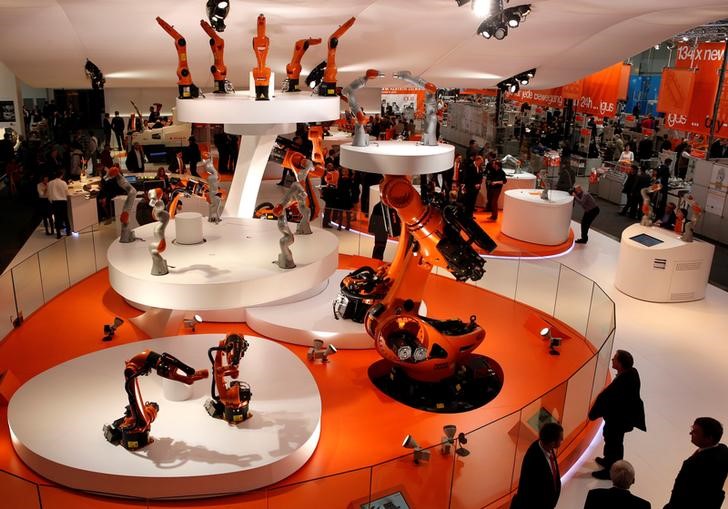
Barclays estimates the humanoid robot market could reach as much as $200 billion by 2035, with a broader physical AI ecosystem valued at up to $1 trillion. Global deployments are projected at about 15,000 units in 2025, rising to roughly 60,000 in 2026 as costs fall from around $3 million per robot a decade ago to about $100,000 today. The report points to manufacturing, logistics, warehousing, healthcare, and household use cases as commercialization expands.
Humanoid robotics is less a single-product story than an enabling-stack story: the biggest near-term winners are not the robot OEMs, but the component suppliers that sit behind every unit shipped. If the industry really scales from pilot deployments to tens of thousands of units, actuator content, power management, edge AI compute, and battery supply become the bottlenecks, which means gross-margin expansion can accrue to the picks-and-shovels names long before end-market monetization is proven.
The second-order implication is labor arbitrage pressure in the most standardized tasks first, not broad job displacement all at once. That puts the earliest economic risk on warehouse operators, contract logistics, light manufacturing, and certain construction workflows where uptime and payback periods can be modeled tightly; healthcare and household use cases remain more of a regulation/reliability option value story. The adoption curve is likely to be lumpy, with procurement cycles and integration bottlenecks creating bursts of order flow rather than a smooth S-curve.
The key contrarian point is that current enthusiasm may be underestimating how capital-intensive deployment is for end users even if unit prices keep falling. Buyers need software integration, service contracts, safety certification, and ongoing maintenance, so the true all-in cost curve may not compress as fast as headline robot pricing suggests. That argues for skepticism on the most levered pure-plays, while favoring diversified industrials and semiconductor/ battery suppliers with multiple end-markets.
The main catalyst over the next 6-18 months is evidence of repeatable commercial rollout rather than press-release deployments: order backlog, field uptime, and customer retention. The main tail risk is a reliability event or regulatory incident that freezes enterprise adoption for several quarters, which would disproportionately hit high-multiple robotics names while leaving component vendors relatively insulated.
AI-powered research, real-time alerts, and portfolio analytics for institutional investors.
Request DemoOverall Sentiment
moderately positive
Sentiment Score
0.45
Ticker Sentiment
