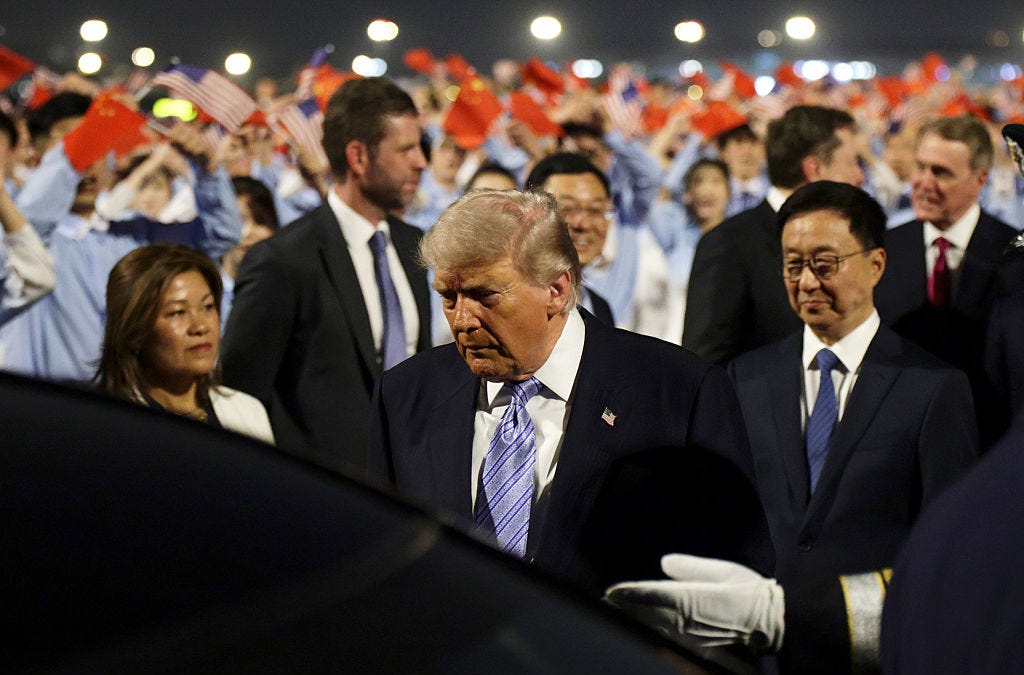
Trump's two-day Beijing summit with Xi Jinping centers on the escalating U.S.-China rivalry, with Taiwan described as the key flash point. The article frames the meeting as a test of détente-style easing between two strategic competitors, implying significant implications for geopolitics, trade, and technology policy. While no concrete policy outcome is reported, the summit carries broad market relevance given the scale of U.S.-China tensions.
The market’s first-order read is “lower headline risk,” but the more important effect is a short-term suppression of policy volatility premium across China-sensitive assets. That helps cyclicals with China exposure, but the cleaner expression is in equity factor rotations: semis, luxury, industrial automation, and commodity-linked names should outperform defensives if the summit produces even a modest de-escalation signal. The second-order loser is any basket trading on a sharper Taiwan escalation path—defense suppliers may not sell off immediately, but implied volatility can compress if the diplomatic tone softens.
The bigger tactical setup is in supply-chain optionality. A friendlier bilateral tone reduces the probability of near-term export controls, port frictions, or retaliatory procurement moves, which matters more for hardware and component chains than for broad indexes. That favors companies with China revenue but limited policy scrutiny, while hurting firms priced for a rapid onshoring wave; the latter could underperform if investors conclude the “China+1” premium is being brought forward too aggressively.
The contrarian risk is that market participants may confuse summit optics with durable policy change. If Taiwan remains the core flash point, any post-meeting implementation failure could reprice risk quickly over a 1-4 week window, especially in semiconductors and defense-adjacent names. The asymmetry is that positive headlines can cap downside for days, but one follow-up headline on sanctions, tariffs, or military signaling can unwind the move faster than it built.
For portfolios, the setup argues for selective beta-taking rather than broad risk-on. The best expression is to own China leverage where balance sheets are strong and policy sensitivity is low, while keeping explicit tail hedges in the most Taiwan-exposed names. Avoid chasing a wholesale de-risking of geopolitical hedges until there is evidence that summit language is translating into trade or export-control concessions.
AI-powered research, real-time alerts, and portfolio analytics for institutional investors.
Request DemoOverall Sentiment
neutral
Sentiment Score
-0.10
