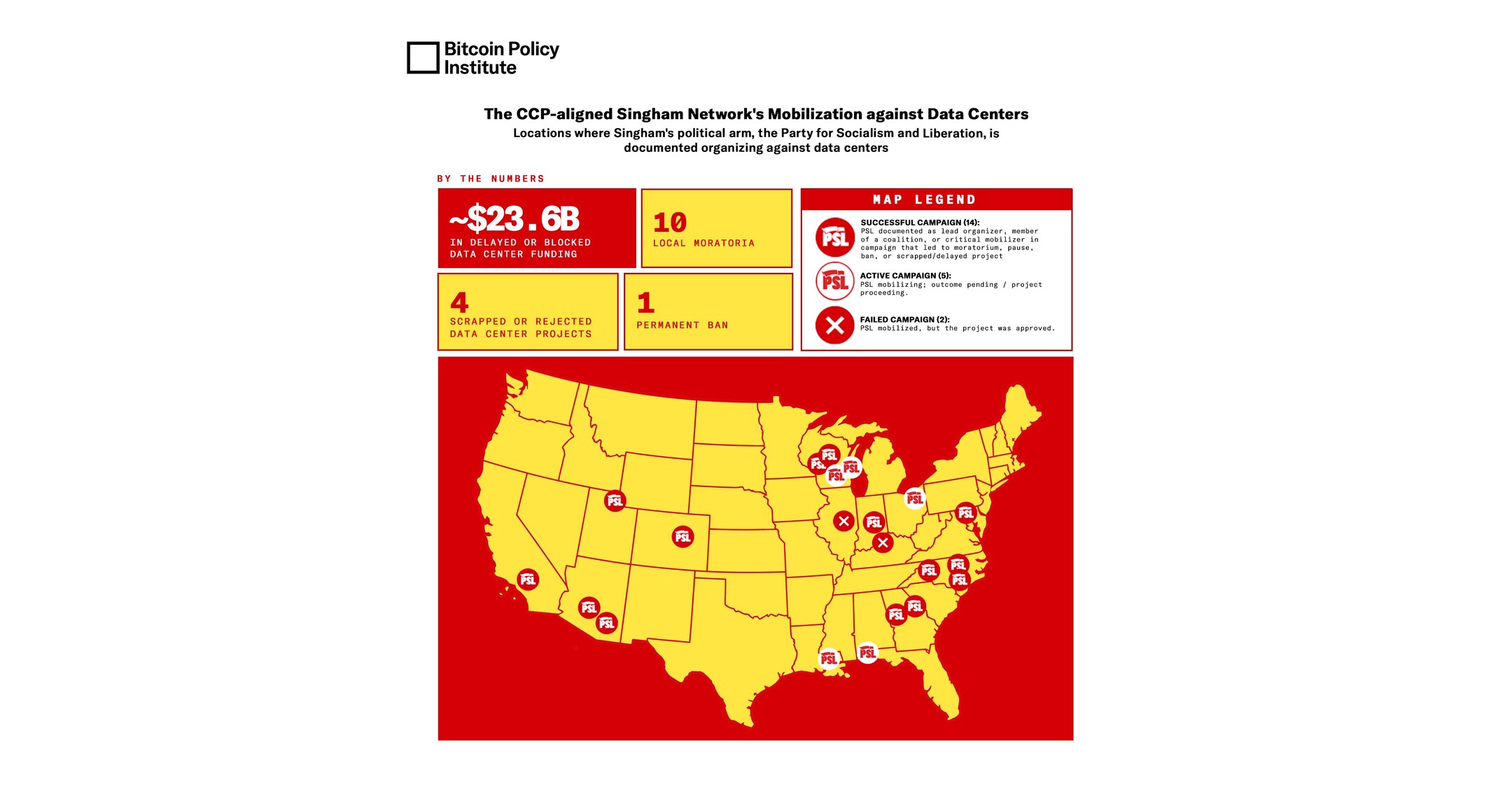
Bitcoin Policy Institute’s Part II report alleges Neville Singham-linked PSL activity delayed/blocked or scrapped about $23.6B of proposed U.S. AI data center investment via 21 campaigns across 14 states, including a $5B project permitting halt (Prince George’s County, MD) and blocking a $12B Blackstone-backed campus (DeForest, WI). The report highlights largely opaque PSL funding (no Form 990; limited donor disclosure) and points to intensifying U.S. scrutiny—DOJ/FBI requests and a Southern District of New York grand jury investigation—while OpenAI flagged a likely Chinese influence operation (“Data Center Bandwagon”). Overall, the news raises material policy and execution risk for the U.S. AI infrastructure buildout.
The market should treat this as a permitting-friction story, not a demand destruction story. The immediate losers are the names with the most leverage to greenfield AI campuses and utility interconnect growth: data-center REITs, electrical equipment, and EPC chains that rely on projects converting from announcement to construction on schedule. The second-order effect is a delayed revenue-recognition problem, where book-to-bill can stay intact for a while but backlog turns less bankable, compressing multiples before earnings do.
The bigger near-term risk is that state and local opposition becomes more organized, which can push some capex from "this year" into "next year" without changing the ultimate need for capacity. That favors incumbents with already-energized sites and contract-backed capacity, while punishing developers and suppliers that need a steady cadence of new permits. Over 6-18 months, the key variable is whether hyperscalers simply reroute spend to friendlier jurisdictions; if so, the buildout survives, but regional winners shift toward power-rich markets and away from politically contested states.
The contrarian read is that exposing opaque influence may weaken the credibility of moratoria rather than strengthen them. If regulators start viewing local campaigns as polluted, approvals could actually accelerate and the headline becomes bullish for deployment. This is not a broad AI demand problem; it is a timing and siting problem. Falsification comes if permitting backlogs widen further and management teams start cutting 2026-27 capex guidance, not just talking about delays.
AI-powered research, real-time alerts, and portfolio analytics for institutional investors.
Request DemoOverall Sentiment
moderately negative
Sentiment Score
-0.55
Ticker Sentiment
