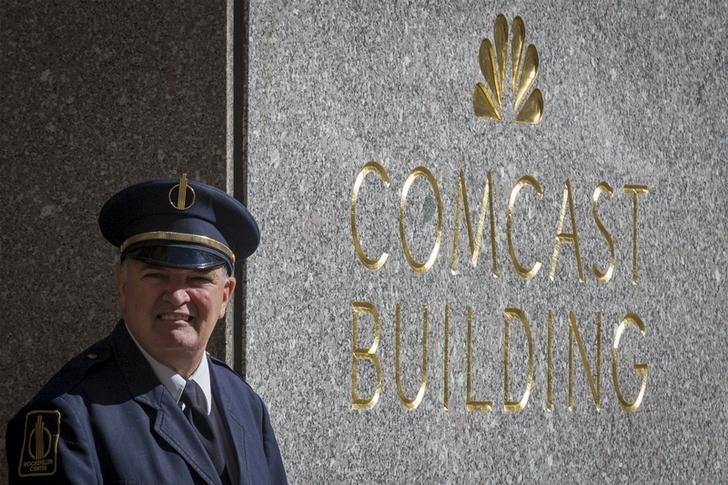
Deutsche Bank downgraded Comcast to Hold from Buy and cut its price target to $34 from $35, citing lower 2027+ EBITDA and free cash flow estimates and limited upside from current levels. The firm sees intensifying broadband competition from fiber, LEO satellite constellations, and fixed wireless, though Comcast’s Q1 2026 results still beat expectations with EPS of $0.79 vs. $0.72 consensus and revenue of $31.46B vs. $30.37B. RBC separately raised its target to $32 from $31 while maintaining Sector Perform.
This is less a one-day research call on Comcast and more a signal that the cable sector’s terminal multiple is getting repriced lower because the competitive battleground is shifting from churn management to structural access competition. The key second-order effect is not just slower broadband adds; it is margin compression from defensive pricing, higher promo intensity, and rising customer acquisition cost as every incumbent is forced to spend to hold share. That dynamic should disproportionately pressure the lower-quality operators and leave the market rewarding businesses with stronger ancillary monetization rather than pure connectivity exposure.
The more interesting implication is that fiber overbuild and fixed wireless are not symmetric threats. Fiber is a durable share taker in dense markets because it attacks the product attribute cable used to own—reliable speed—while fixed wireless is more of a near-term pricing disruptor that can cap ARPU and delay upgrades. That means the next leg of earnings revisions is likely to come through a slower revenue line first, then leverage deterioration later as legacy infrastructure remains largely fixed cost; the market usually underestimates that lag by 2-4 quarters.
For Comcast specifically, valuation may look cheap on current-year cash flow, but the market will not pay for optically high FCF if that cash flow is increasingly used to defend a shrinking core. The real wildcard is whether Theme Parks can remain a counterweight; if consumer demand softens, the perceived diversification benefit fades and the stock reverts toward a cable multiple floor rather than a sum-of-the-parts story. In other words, the bearish case is not about one bad quarter—it is about the market losing confidence that the legacy business can offset secular erosion long enough for non-core assets to matter.
Contrarianly, the sell-side may be late to downgrade duration while the stock has already de-rated into a value box. If broadband losses stabilize even modestly, the combination of high FCF yield and buyback capacity can produce an abrupt squeeze higher because the short interest/underownership base is likely not huge. The cleaner trade is to own the relative winners of network-quality competition rather than short the entire group outright.
AI-powered research, real-time alerts, and portfolio analytics for institutional investors.
Request TrialOverall Sentiment
mildly negative
Sentiment Score
-0.15
Ticker Sentiment
