China’s humanoid robotics sector showed a major capability jump, with more than 100 robots competing in a half-marathon and the winning unit from Honor finishing in 50 minutes and 26 seconds. The event highlights rapid progress in robotics performance and Beijing’s ongoing policy push to build a global leader in humanoid automation, with potential implications for industrial and defense applications. While the article is not company-specific, it signals strengthening momentum in China’s technology ecosystem.
The important takeaway is not the spectacle of humanoid speed, but the signal that China is moving from novelty demos to repeatable systems engineering in robotics. That shifts the value chain away from “single flagship robot makers” toward the picks-and-shovels stack: actuator suppliers, industrial software, edge AI, battery/thermal components, and factory automation integrators. The market is still underpricing how quickly a state-backed ecosystem can compress the learning curve once physical testing becomes large-scale and public.
Second-order effects likely show up first in labor-intensive sectors rather than in consumer robotics. If China can keep improving uptime and dexterity, the near-term winners are logistics, electronics assembly, hazardous inspection, and warehouse automation—segments where ROI can be proven in 12-24 months, not in consumer adoption cycles. The losers are high-volume low-margin manufacturers reliant on cheap manual labor across Asia; the competitive pressure is not just domestic displacement but export deflation as Chinese firms learn to manufacture at lower unit cost.
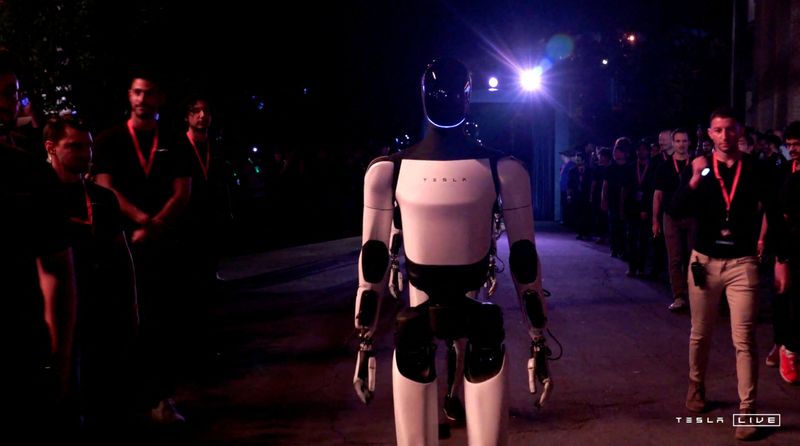
For TSLA, the relevance is less about the robot race itself and more about validation of embodied AI and manufacturing ambition. The equity is still trading on a binary option-like thesis: if Optimus becomes a scaled product, the multiple expands meaningfully; if not, the robotics narrative remains an expensive side quest. Near term, this news is mildly constructive for sentiment but not a catalyst by itself—what matters over the next 6-18 months is whether Tesla can demonstrate closed-loop task completion, serviceable uptime, and a credible BOM cost curve.
The contrarian view is that public demos can overstate industrial readiness. China may be good at mobilizing capital and talent, but robotics commercialization usually breaks on reliability, maintenance economics, and safety certification, which are slower to solve than raw speed. That means the move is constructive for the ecosystem but still premature for broad end-market monetization; the best risk/reward is likely in infrastructure suppliers and automation beneficiaries rather than the headline robot names.
AI-powered research, real-time alerts, and portfolio analytics for institutional investors.
Request DemoOverall Sentiment
mildly positive
Sentiment Score
0.25
Ticker Sentiment
