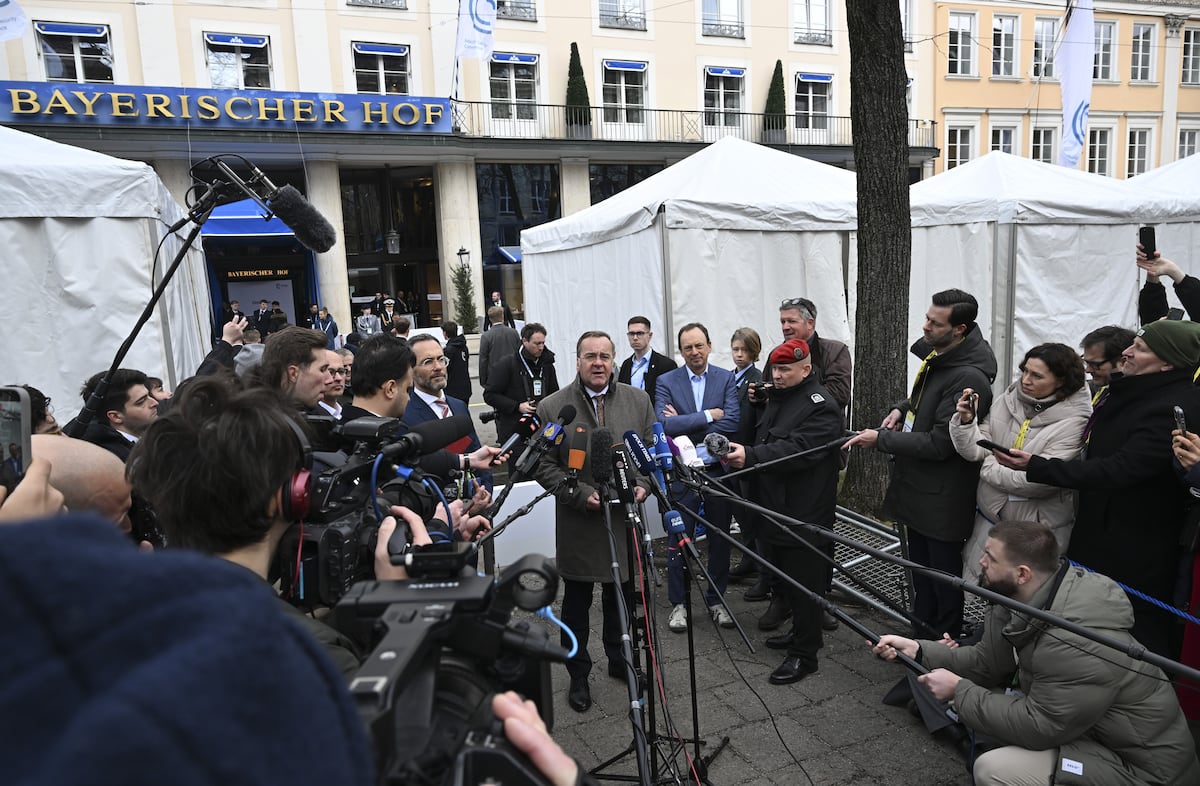
The Munich Security Conference opens with German Chancellor Friedrich Merz speaking and about 15 EU heads of state or government expected, alongside high-profile attendees including Ukrainian President Volodymyr Zelenskyy, Chinese FM Wang Yi and a large U.S. congressional delegation led this year by Secretary of State Marco Rubio. The gathering highlights tensions in trans-Atlantic relations after last year’s confrontational U.S. rhetoric and a recent, later-withdrawn Trump tariff threat related to Greenland, while NATO allies have agreed to a sizeable upward shift in defense spending. For investors, the conference underscores continued political risk around U.S.-Europe trade policy and a potential sustained increase in European defense budgets, which could favor defense contractors but also sustain cross-border policy uncertainty for multinational trade and supply chains.
Market-structure: The Munich conference signals a sustained re-rating toward defense and security sectors as NATO/EU members move from rhetoric to procurement; a conservative estimate is an incremental €50–100bn pa in European defense spend over 1–3 years (0.3–0.7% of EU GDP) which should lift revenues of prime contractors and European suppliers. Winners: US/European defense primes (Lockheed LMT, Northrop NOC, Raytheon RTX, BAE/LSE/airbus suppliers) and cybersecurity (PANW, CRWD); losers: discretionary exporters sensitive to tariff volatility and smaller sub‑contractors with concentrated single-country exposure.
Risk assessment: Tail risks include a renewed US‑EU tariff spat, a major escalation in Ukraine, or a US‑China breakdown that disrupts supply chains — each could spike volatility and commodity prices (oil +15–30% in extreme scenarios). Time horizons: headline-driven moves in days, procurement contract re‑rating over 3–12 months, structural revenue lift over 1–3 years; hidden dependencies include long procurement cycles, offset/industrial policy clauses and export controls that can shift who captures orders.
Trade implications: Tactical trades should favor 6–12 month exposure to defense and cybersecurity while hedging macro risk: ETFs/large-cap primes for directional, call spreads to limit premium spend, and EUR long/commodities for reflation/geopolitics. Cross-asset: expect modest upward pressure on sovereign yields in Europe (10–30bp) and potential USD safe-haven bid on escalations; energy names benefit if conflict risk rises.
Contrarian angles: Consensus may front-run primes but underweight smaller cybersecurity/software names that win recurring revenue from governments; procurement timelines mean convertibility of budget to sales likely 6–18 months — if markets price immediate wins, there is shortable opportunity into strength. Historical parallel: post‑2014 Ukraine, defense primes outperformed over 12–36 months but only after contract signals; watch procurement announcements, not speeches.
AI-powered research, real-time alerts, and portfolio analytics for institutional investors.
Request DemoOverall Sentiment
neutral
Sentiment Score
-0.05
