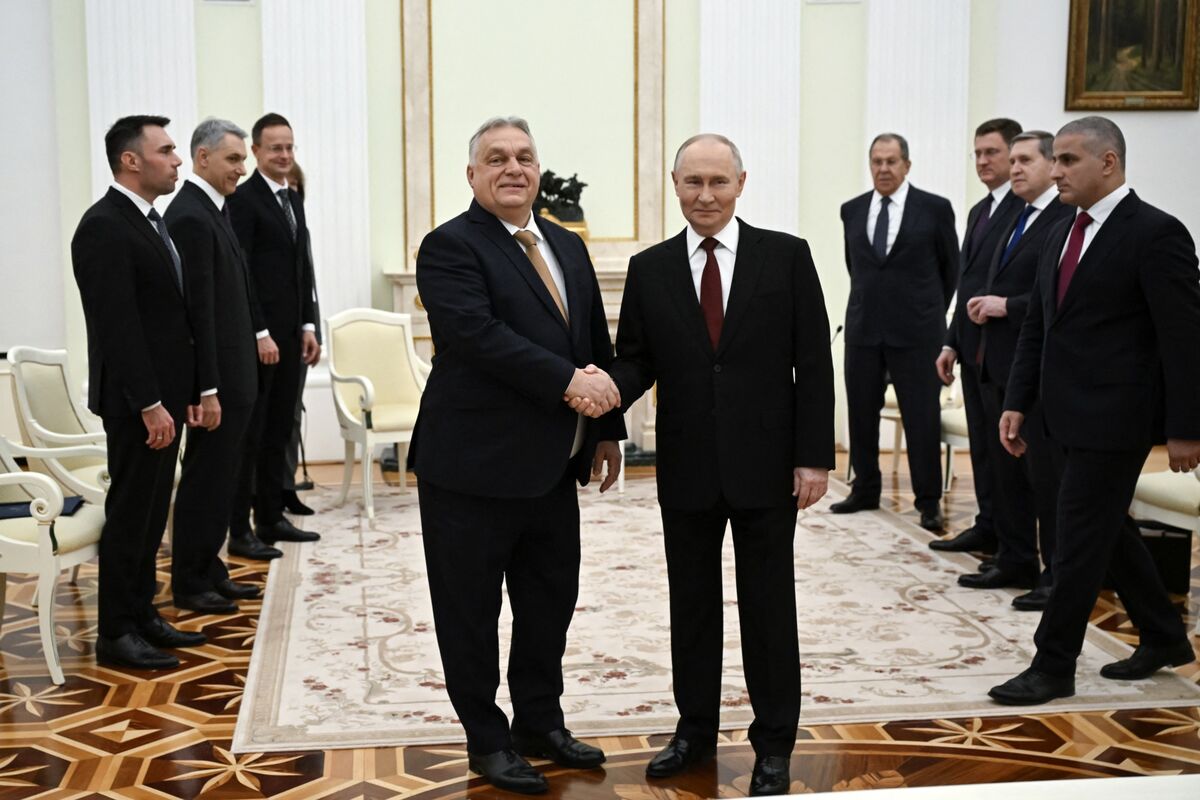
President Vladimir Putin met with Hungarian Prime Minister Viktor Orban at the Kremlin to discuss the fate of Russian oil refineries that are under sanctions and have raised concerns about fuel shortages across eastern Europe. Interfax cited Deputy Prime Minister Alexander Novak saying Hungary's potential purchase of sanctioned assets was discussed and that negotiations should be held privately — a development that could alter regional fuel supply dynamics, sanctions enforcement risks, and political exposure for energy markets in the region.
Market structure: A Hungary-led acquisition of sanctioned Russian refineries would re-route refined-product flows into Central/Eastern Europe, benefitting Hungarian-integrated players (MOL) and traders able to access discounted Russian feedstock, while pressuring Western/EU refiners exposed to diesel/gasoil exports into the region (OMV, PKN). Expect regional diesel/gasoil spreads to move +/-15% intra-quarter versus ICE Brent depending on whether flows are restored or remain curtailed; pipeline logistics and insurance will determine pricing power more than nominal capacity.
Risk assessment: Tail risks include EU secondary sanctions on a purchasing state (probability 5-15%) or a Russian cutoff of crude to non-compliant operators (5-10%), which could blow out CE product spreads and widen Hungary-Germany 5y CDS by 100-200bps within months. Immediate (days) volatility in product swaps, short-term (weeks–months) contractual re-routing, and long-term (quarters–years) ownership/legal entanglements are key time horizons; hidden dependency: insurance/bunkering access and EU market access clauses in offtake contracts.
Trade implications: Tactical volatility trades on ICE Gasoil and HUF FX are preferred over directional crude longs. Favor equity exposure to Hungarian/refining names with state ties (MOL) while hedging political risk via sovereign CDS or short HUF if spreads widen; avoid vanilla long positions in export-dependent EU refiners without hedges. Options provide asymmetry: buy volatility around negotiation windows (next 30–90 days) rather than outright physical positions.
Contrarian angles: Consensus assumes prolonged Eastern European shortages; but if Hungary secures assets and maintains sanctioned status via legal workarounds, regional supply could normalize and compress diesel/gasoil premia by 10–20% over 3–6 months — a scenario markets underprice. Conversely, the worst-case sanction escalation is underappreciated by equity holders; deploy small, costed hedges rather than outright directional bets.
AI-powered research, real-time alerts, and portfolio analytics for institutional investors.
Request DemoOverall Sentiment
neutral
Sentiment Score
0.00
