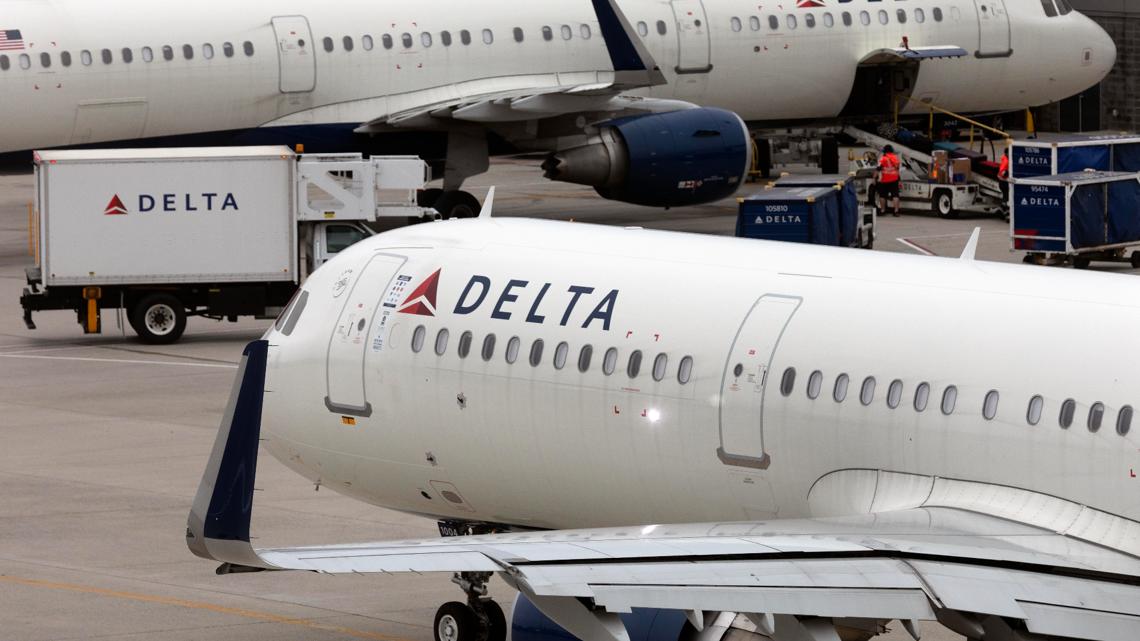
Delta will proactively process flight cancellations at its MSP hub and other Midwest airports ahead of heavy snow forecast for March 14-15. Customers booked for March 14-15 may rebook with no change fee and no fare difference for travel completed by March 22, can cancel and apply ticket value toward future travel within one year, and rebookings after March 22 may incur fare differences. The disruption is localized to the Midwest network (MSP, Brainerd, Duluth, Hibbing, Rochester, Sioux Falls, Des Moines, Madison, Milwaukee, Green Bay and other smaller communities) and poses short-term operational and customer-service impacts rather than material firmwide financial risk.
A concentrated Midwestern hub disruption is not just a near-term revenue/time-of-travel problem — it creates multi-day operational drag: crew mispositioning, cascading cancellations on connecting itineraries and higher IRROPS staffing/ironing costs that typically persist 48–96 hours after the weather clears. Historically, a multi-day hub event of this scale produces incremental opex in the low tens of millions for a large network carrier and forces yield dilution because of forced re-accommodations and one-way refunds that depress realized yield on rebooked seats for the following 1–2 weeks.
Second-order beneficiaries are players that monetize schedule rigidity or offer alternate modes: regional rail and long-haul bus operators can pick up incremental flow on select corridors within 24–72 hours, while airport service vendors (de-icing, ground-handling contractors) see near-term revenue but not margin expansion — their capacity constraints, not demand, are the bottleneck. Conversely, regional partners that feed the hub (regional jets and contract carriers) face outsized idling costs and potential maintenance scheduling conflicts that can reduce available lift for peak recovery days, extending the demand-supply mismatch beyond the immediate weather window.
The event is a short-duration shock; the principal reversal catalyst is efficient recovery of crew/aircraft positioning and a warmer-than-expected forecast within 48 hours. The real tail risk is repeated or sequential weather events this season — two or more clustered IRROPS incidents can materially raise unit costs and weaken seasonal margin assumptions for the next 3–6 months, creating a window where network carriers under-perform lower-structure leisure carriers regardless of macro demand trends.
AI-powered research, real-time alerts, and portfolio analytics for institutional investors.
Request DemoOverall Sentiment
neutral
Sentiment Score
0.00
Ticker Sentiment
