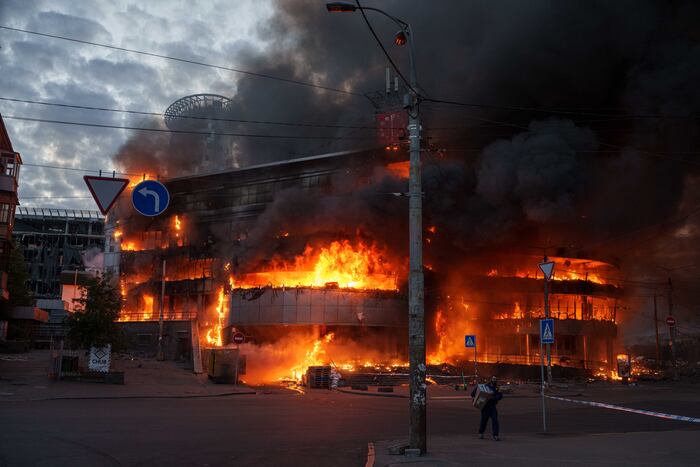
Russia launched a mass overnight assault on Kyiv using 600 strike drones and 90 missiles, with Ukrainian officials saying at least 2 people were killed and 56 injured. Zelenskyy also said Russia used the hypersonic Oreshnik ballistic missile for the third time in Ukraine, targeting Bila Tserkva in the Kyiv region. The attack damaged 40 locations across Kyiv and underscores elevated geopolitical and defense risk.
This is less a single event than evidence of escalation in Russia’s capability signaling: a higher-end strike package being used to stretch Ukraine’s air defense economics and force dispersion of scarce interceptors. The key second-order effect is not battlefield damage alone, but that each wave consumes expensive defensive inventory and maintenance capacity faster than Ukraine can replenish it, increasing the probability of localized gaps over the next several weeks. That favors suppliers with replenishment exposure, but also raises the odds of a broader European procurement acceleration if allied governments conclude the current defensive architecture is being outpaced.
The more important market implication is for defense budgets and industrial bottlenecks, not headline risk-off. If this pattern persists for 1-3 months, the beneficiaries are not just missile primes but firms with throughput in air defense sensors, interceptors, propulsion, and battlefield C2 software, because the limiting factor becomes volume delivery rather than R&D. Downstream, European utilities, rail, and industrial assets with physical exposure in the region face a higher tail-risk premium, but the broader equity market should treat this as a defense capex impulse rather than a systemic risk event unless escalation crosses NATO-adjacent thresholds.
The contrarian miss is that repeated use of a prestige weapon can be a sign of tactical depletion or political theater, not only capability growth. If the missile remains rare, markets may overestimate its marginal military utility and underprice the fact that the real constraint is mass production and launch platform survivability. That means the trade is better expressed through durable procurement beneficiaries than through broader geopolitical hedges, which often fade after the first few headline cycles.
Over the next 2-8 weeks, the catalyst stack is: allied resupply announcements, revised European defense budgets, and any evidence of interceptor shortages or damaged infrastructure compounding in Kyiv. The main reversal case is de-escalation rhetoric without follow-through or a ceasefire/negotiation framework that shifts spending urgency lower. Until then, the asymmetry favors being long defense order flow rather than shorting risk assets broadly.
AI-powered research, real-time alerts, and portfolio analytics for institutional investors.
Request DemoOverall Sentiment
extremely negative
Sentiment Score
-0.90
