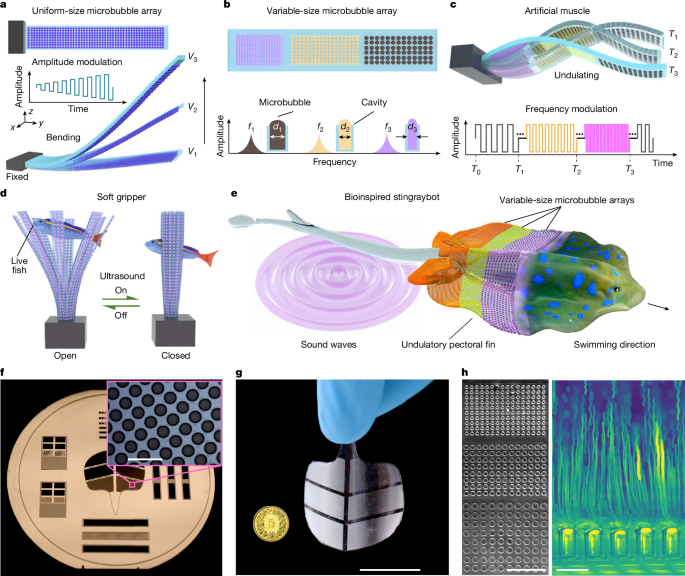
A new class of soft artificial muscles has been developed, utilizing acoustically activated microbubble arrays to achieve programmable, wireless actuation with high force intensity (approximately 7.6 μN mm−2), rapid response (sub-100 ms), and a compact, lightweight design. This innovation is poised to be transformative across multiple sectors, including soft robotics, wearable technologies, haptics, and biomedical instrumentation, such as prosthetics, surgical tools, and targeted drug delivery, indicating significant future market opportunities. While demonstrating broad applicability, current limitations include microbubble stability during prolonged actuation and distance-dependent performance, which necessitate further optimization for widespread commercial deployment.
A novel class of soft artificial muscles, leveraging acoustically activated microbubble arrays, has been introduced, demonstrating significant advancements in programmable actuation. This technology achieves high force intensity of approximately 7.6 μN mm−2, rapid responsiveness under 100 milliseconds, and a compact design with 3,000 microbubbles per mm2, all while being lightweight at 0.047 mg mm−2. Its wireless controllability via ultrasound offers a material-independent and biocompatible alternative to existing muscle technologies.
The innovation presents transformative potential across diverse fields, including soft robotics, wearable technologies, and haptics, with particular promise in biomedical applications such as prosthetics, soft surgical tools, and targeted drug delivery. Demonstrated applications range from delicate object manipulation to biomimetic propulsion, highlighting its versatility and ability to overcome limitations of current tethered or complex actuation mechanisms.
Despite its strong positive sentiment and high market impact potential, the technology faces challenges including microbubble stability during prolonged actuation (beyond 30 minutes) and distance-dependent performance, where deformation reduces by approximately 50% at 5 cm. Future research aims to address these limitations through geometric optimization, enhanced scalability, and integration into complex devices, indicating a long development pathway towards widespread commercialization.
AI-powered research, real-time alerts, and portfolio analytics for institutional investors.
Request DemoOverall Sentiment
strongly positive
Sentiment Score
0.85
