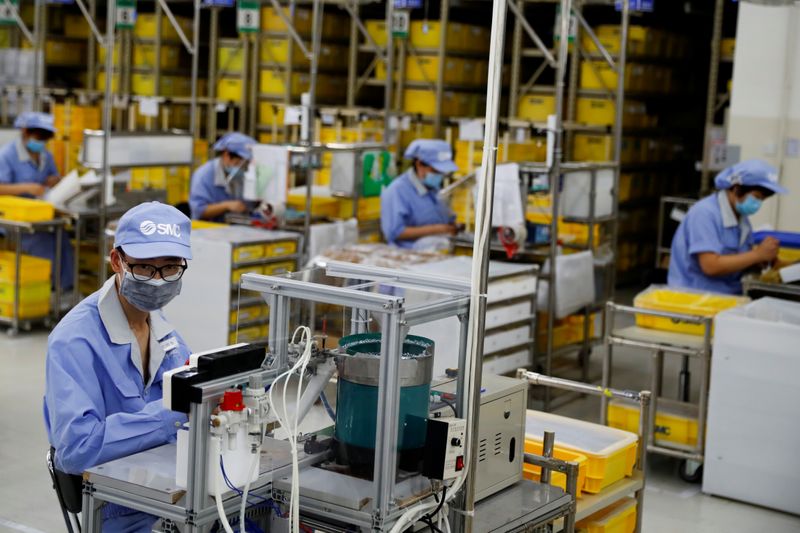
China posted 5.0% year-on-year GDP growth in Q1 2026, but labor-market indicators are weakening, with 16–24 unemployment at 16.9% and the 25–29 cohort at a record 7.7%. Citi warns AI-related displacement could push youth unemployment toward 20% by mid-year, while roughly 70 million jobs are seen at risk of automation. The article also flags softening consumption, with retail sales potentially near zero growth and Beijing considering stimulus such as service vouchers and targeted support for younger workers.
The market implication is less about a broad AI slowdown than a rotation in the winners: if compute demand is increasingly constrained by power, memory, and data-center economics, then CPU-heavy and systems-integrated names can re-rate relative to pure GPU beta. That makes INTC the cleaner relative-beneficiary here, not because it wins the AI race outright, but because any shift toward edge inference, heterogeneous compute, and cost-conscious enterprise deployments improves its relevance while compressing the premium attached to unconstrained accelerator growth. NVDA remains the quality franchise, but the marginal upside now looks more dependent on supply-chain execution and capex digestion than on narrative alone.
The China labor backdrop matters for semis through demand elasticity, not just geopolitics. Rising youth underemployment and weaker household balance sheets tend to hit discretionary electronics replacement cycles first, then spill into enterprise IT spending with a lag of 2-4 quarters; that argues for more caution on SMCI and APP than the headline AI trade would suggest. If Beijing responds with consumption support, it may stabilize low-end hardware demand, but it is unlikely to offset the margin pressure from softer utilization and inventory normalization if end-demand keeps fading.
The contrarian read is that the consensus may be underestimating how quickly policy can mute the social fallout from AI-linked labor stress. If China front-loads vouchers, youth employment subsidies, or local credit support into the next 1-2 quarters, the negative read-through to consumer internet and ad-tech names could prove temporary, particularly for companies with pricing power and U.S.-centric revenue bases. The bigger risk is that investors extrapolate a one-way labor shock into a prolonged macro slowdown; the more likely path is intermittent stimulus that creates tradable mean reversion rather than a clean structural collapse.
AI-powered research, real-time alerts, and portfolio analytics for institutional investors.
Request DemoOverall Sentiment
moderately negative
Sentiment Score
-0.35
Ticker Sentiment
