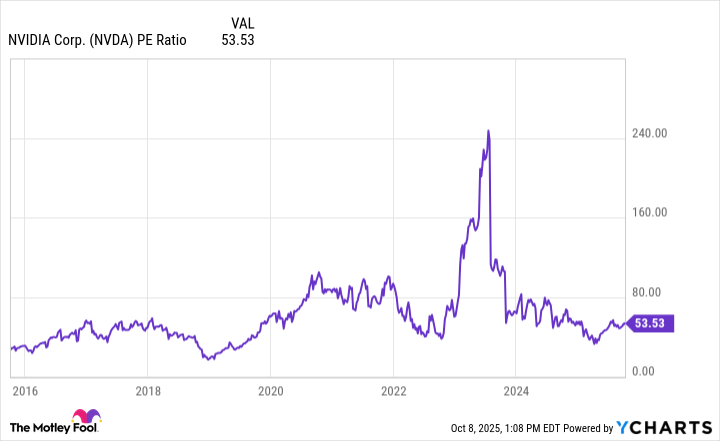
Nvidia, with a $4.5 trillion market capitalization, is reinforcing its dominant AI chip position through a $100 billion investment in OpenAI, securing future sales of its advanced chips, including the new Rubin series from 2026, for a massive 10-gigawatt data center expansion. While major customers are developing proprietary AI chips, Nvidia currently maintains a significant technological lead in efficiency and processing power. However, the company's high P/E ratio of 53 reflects substantial future growth expectations, and the article cautions about potential volatility in AI data center spending, suggesting Nvidia's market cap could remain flat or even decline within five years if demand slows, despite its current strong position.
Nvidia (NVDA), currently valued at a $4.5 trillion market capitalization with its stock at $188 as of October 8th, maintains a dominant position in the AI computer chip market. The company is strategically reinforcing this lead through a significant $100 billion investment in OpenAI, which will secure future purchases of Nvidia chips, including the advanced Rubin series from 2026, to build 10 gigawatts of computing capacity, representing approximately 20% of the existing U.S. data center footprint.
Despite this strategic partnership, Nvidia faces increasing competition as major customers like Alphabet, Amazon, Microsoft, and Meta Platforms develop their own custom AI chips. While these proprietary chips are not yet as powerful or efficient as Nvidia's latest models, the long-term impact of customer self-sufficiency on demand remains a key consideration.
The company's P/E ratio of 53 indicates substantial future growth expectations, but the market outlook for AI data center spending introduces considerable uncertainty. There is a risk that a potential bust in demand could halve Nvidia's revenue within five years if data center players outpace actual customer demand for AI software.
Given the high valuation and potential for volatility in AI spending, the article suggests Nvidia's market cap could remain flat or even decline over the next five years. This cautious outlook contrasts with the company's strong past performance and current market dominance, highlighting the inherent risks in hypergrowth stocks.
AI-powered research, real-time alerts, and portfolio analytics for institutional investors.
Request DemoOverall Sentiment
moderately negative
Sentiment Score
-0.45
Ticker Sentiment
