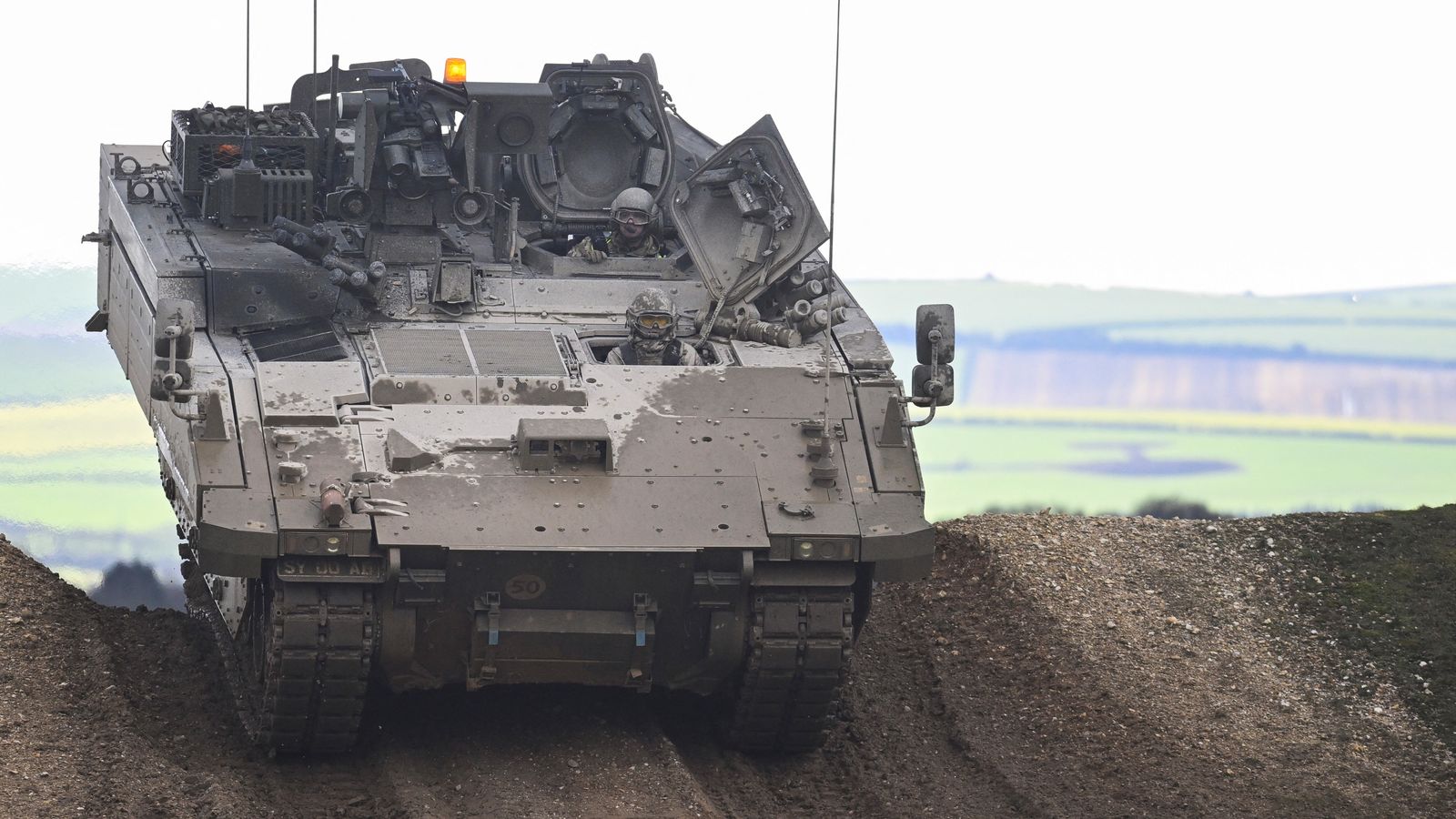
The UK has paused all trials of the Ajax armoured vehicle after a soldier reported vibration symptoms on 12 December, extending a suspension first introduced in November after around 30 personnel suffered noise and vibration issues following a 26 November exercise. The vehicle, built by General Dynamics at nearly £10m apiece and weighing over 40 tonnes, is part of a 589-unit order due by 2030; 45-point inspections have been completed on implicated vehicles and further vibration-specific tests are under way on 13 units (the remaining 10 pending). An Army investigation and a Defence Accident Investigation Branch probe are ongoing, and reliability trials that were providing data for safety work have been paused until at least the New Year, creating program and contractor execution risk for investors monitoring defence procurement exposure.
Market structure: This incident is a targeted hit to General Dynamics' (GD) UK armoured-vehicle program rather than the global defence market — GD is the clear near-term loser (reputational, potential penalties) while diversified primes (LMT, NOC) and specialist retrofit/NVH vendors (e.g., Parker-type suppliers) are relative beneficiaries if remediation contracts follow. Pricing power for systems integrators could weaken short-term as governments push for concessions; demand for replacement armoured capacity remains intact, implying only timing risk to orders valued at roughly £5.9bn (~$7.5bn) for 589 vehicles.
Risk assessment: Immediate risk (days) is a volatility spike and reputational headlines; short-term (weeks–months) risk centers on investigation findings and possible fines or mandated retrofits; long-term (years) risk is program delays shifting ~3–5% of GD’s annual revenue recognition into later fiscal years. Tail risks: program cancellation (~low probability) or broader UK procurement clampdowns (medium) could create >15% downside to GD UK revenue; hidden dependency — UK political pressure and soldier health litigation could amplify costs beyond remediation.
Trade implications: Short-term tactical: buy 3–6 month GD downside protection (Mar–Jun 2026 puts or bear put spread) sized to 1–2% notional; pair trade by going long LMT (equal notional) while shorting GD to express idiosyncratic risk. Sector rotation: favor diversified defence names (LMT, NOC) and NVH/vehicle systems suppliers; avoid concentrated single-contract primes until January investigation conclusion. Key catalysts to watch: MOD report in Jan 2026, any discovery of systemic design flaw, and GD’s next quarterly guide — act around those dates.
Contrarian angle: Consensus overstates cancellation risk — UK still needs replacements and will likely fund remediation, creating a 20–40% mean-reversion upside if trials resume without further injuries. Mispricing window: consider accumulating GD on >10% headline-driven drawdown over a 5–10 day stretch or selling premium if 30‑day IV >40% (collecting rich options premium). Historical analogue: defence procurement scares (e.g., past armoured vehicle fixes) produced 6–12 month rebounds once technical fixes deployed.
AI-powered research, real-time alerts, and portfolio analytics for institutional investors.
Request DemoOverall Sentiment
moderately negative
Sentiment Score
-0.45
Ticker Sentiment
