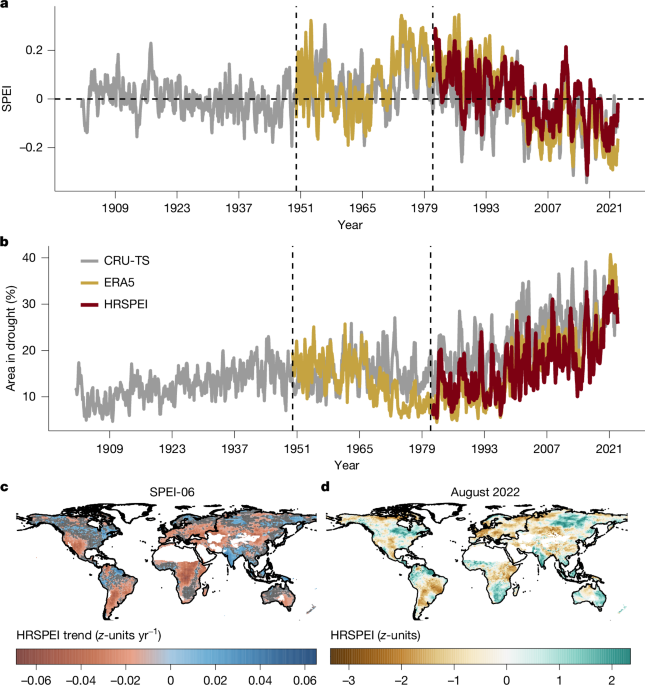
A study of global drought trends from 1901-2022 reveals an increasing trend in drought severity worldwide, with atmospheric evaporative demand (AED) identified as a key driver, contributing to an average 40% increase in severity. The past five years (2018-2022) saw a 74% expansion of drought-affected areas compared to 1981-2017, with AED accounting for 58% of this increase; 2022 was a record-breaking year, with 30% of global land area experiencing moderate to extreme droughts, 42% of which was attributed to increased AED, indicating that both dry and wet regions are experiencing drying trends and that AED will likely continue to drive severe droughts under future warming scenarios.
A comprehensive global study utilizing high-resolution datasets for the period 1901–2022, with detailed analysis from 1981–2022, reveals a significant and accelerating worldwide increase in drought severity. Atmospheric Evaporative Demand (AED), a key climate change-linked driver, is reported to have amplified global drought severity by an average of 40%. This impact is particularly stark in recent years: from 2018–2022, drought-affected areas expanded by 74% on average compared to the 1981–2017 baseline, with AED contributing 58% to this increase. The year 2022 set a record, with 30% of the global land area experiencing moderate to extreme droughts, 42% of which was directly attributed to increased AED. Critically, the research indicates that not only are traditionally dry regions becoming drier, but historically wetter areas are also experiencing significant drying trends. Regionally, accelerated drought magnitude and frequency are evident in southern South America, eastern and central Africa, southern Europe, and the western United States, with AED's contribution to drought trends reaching up to 65% in areas like Africa and Australia. These findings, based on the Standardized Precipitation Evapotranspiration Index (SPEI), highlight escalating threats to water availability, impacting agriculture, energy, industry, and ecosystem stability, and suggest AED's role in driving severe droughts will likely continue to intensify under future warming scenarios.
AI-powered research, real-time alerts, and portfolio analytics for institutional investors.
Request DemoOverall Sentiment
strongly negative
Sentiment Score
-0.80
