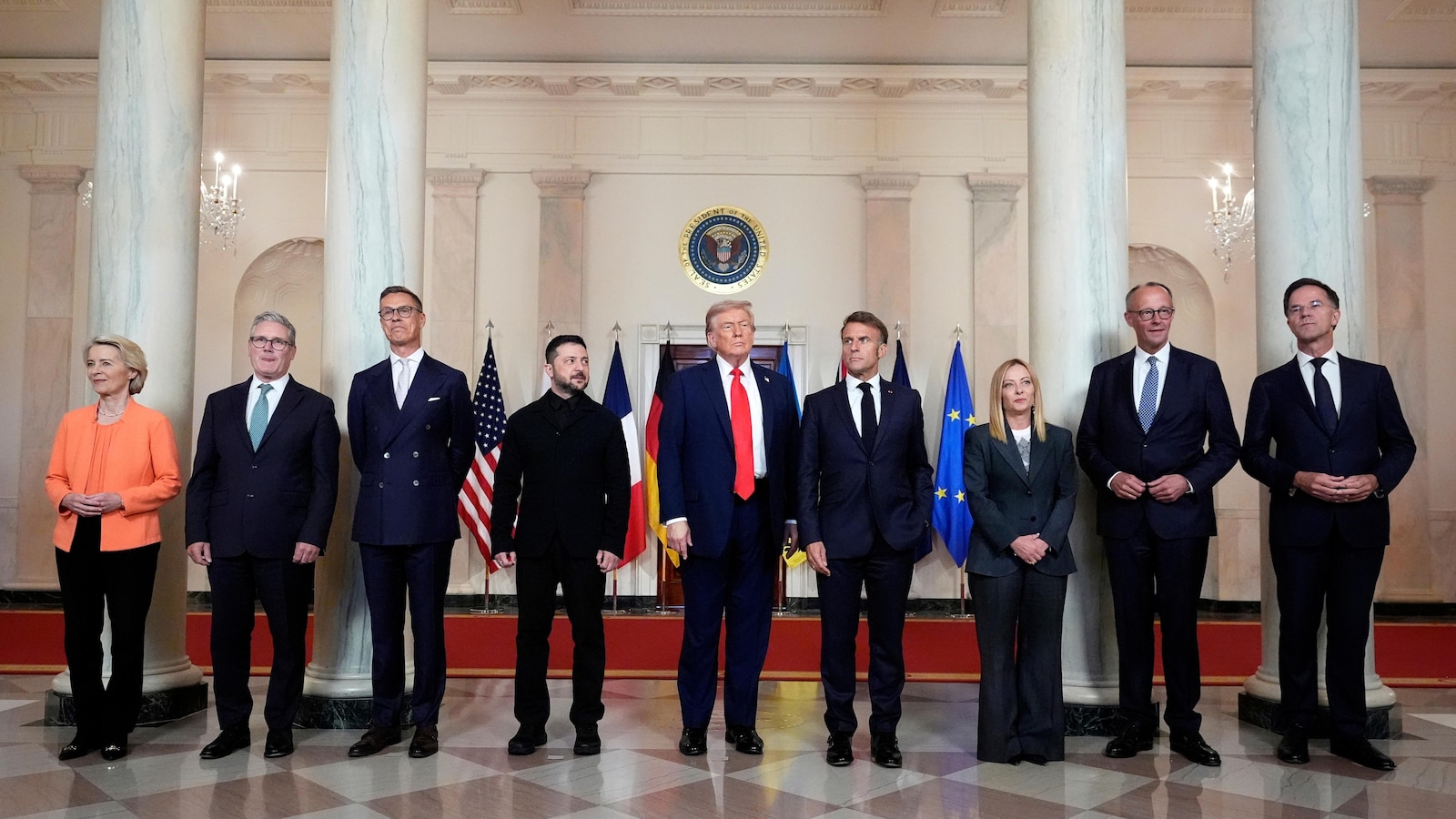
European leaders, led by the UK and France, are struggling to define post-war security guarantees for Ukraine amidst an ongoing conflict and profound uncertainty regarding U.S. involvement. Discussions in Paris reveal a strategic bind, as a proposed "reassurance force" lacks a clear mission, reliable U.S. backing, or a viable ceasefire, particularly given President Trump's shifting stance and past policy reversals. Experts indicate direct troop deployment is improbable and risky, suggesting the most realistic path involves significantly increased military aid to Kyiv, highlighting Europe's challenging geopolitical dilemma and the enduring risk of regional instability.
European leaders are confronting a strategic impasse over post-war security guarantees for Ukraine, with discussions in Paris revealing a deep-seated dilemma driven by the absence of a viable ceasefire and profound uncertainty surrounding U.S. policy. The proposed "reassurance force," estimated to require at least 10,000 troops, is deemed operationally impossible without a clear mission and, critically, reliable backing from the United States. This dependency is exacerbated by U.S. President Trump's wavering commitment, evidenced by his withdrawal from ceasefire demands—a shift toward the Russian position—and a history of reversing international agreements, which makes any U.S. security pledge appear fragile. Furthermore, Russian officials have dismissed the prospect of a ceasefire, rendering the premise of a post-conflict deployment currently untenable. The potential resource strain on European nations is significant; a U.K. contribution of 5,000 soldiers would represent approximately 30% of the British Army's deployable capacity. Given these substantial hurdles and the high risk of deploying troops without U.S. air and intelligence support, the most probable course of action for European nations is to default to providing significantly more weaponry and ammunition to Kyiv, a scenario experts describe as the best among a set of poor options.
AI-powered research, real-time alerts, and portfolio analytics for institutional investors.
Overall Sentiment
strongly negative
Sentiment Score
-0.75
