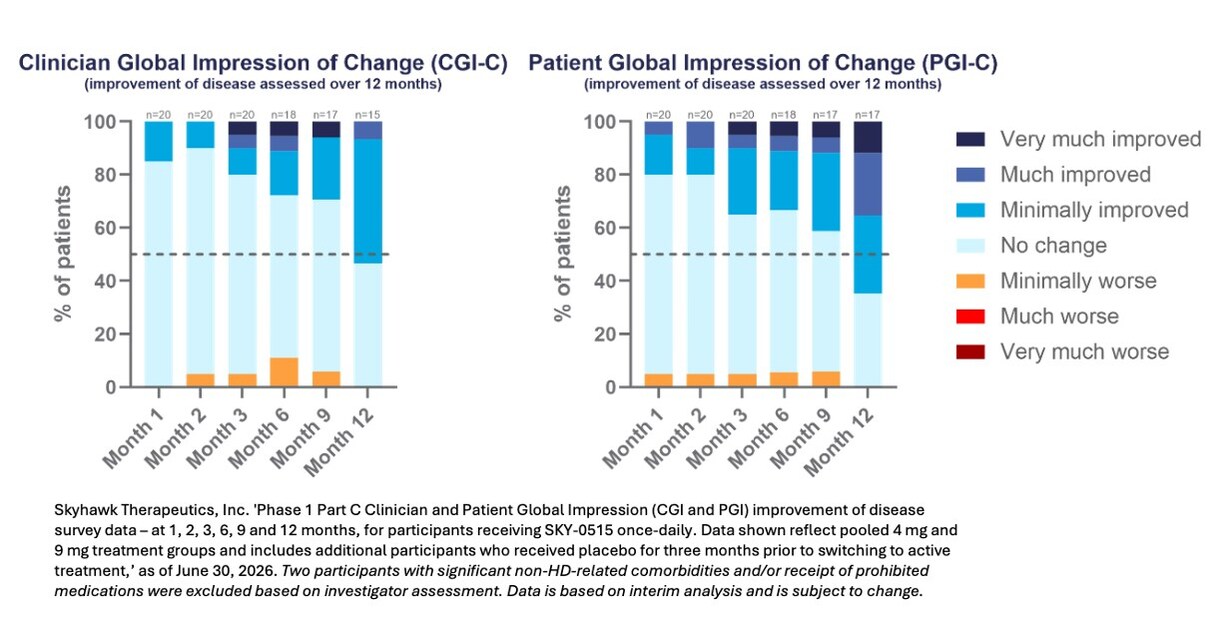
Skyhawk Therapeutics reported 12-month cUHDRS results for SKY-0515 showing favorable average changes versus baseline across functional and motor outcomes (e.g., TFC +0.07 vs -0.87 in propensity-weighted natural history; TMS -2.00 vs +2.21). Clinician/patient CGI-PGI global impressions showed no observed worsening at 12 months in expected-progressors, with 65% of participants and 50% of clinicians reporting improvement. Biomarker effects were dose-dependent with blood mHTT reductions up to 69% and PMS1 mRNA reductions up to 26%, and the drug was described as generally safe and well-tolerated.
This is primarily a platform de-risking event, not a revenue event. The important signal is that an oral CNS small molecule is showing both target engagement and a plausibly translated functional read-through; if that holds, it pressures the premium the market assigns to more burdensome delivery modalities in Huntington’s and, by extension, other CNS rare-disease programs. The incremental winner is the entire “oral, brain-penetrant RNA-modulation” thesis: lower CMC friction, easier chronic dosing, and better real-world adherence should improve partnerability and reduce the discount rate versus intrathecal or one-time approaches.
The second-order loser set is any public competitor whose valuation depends on the assumption that HD will remain an ASO-only market. If future randomized data corroborate the functional trend, it could also pull capital away from broader neurodegeneration baskets toward modality winners with a clearer path to repeat dosing and label expansion. That said, the current readout is still vulnerable to endpoint cherry-picking and small-n noise; open-label impressions and biomarker deltas rarely survive contact with placebo-controlled progression data in neurodegeneration.
The real catalyst path is the next 1-3 months: investors will focus on whether the larger phase 2/3 program can replicate the biomarker slope and preserve cUHDRS separation without safety tradeoffs. Over 6-18 months, the question becomes whether this is a one-program story or proof the SKYSTAR platform can produce a repeatable pipeline. The contrarian risk is that the market overpays for “first signal” optionality before blinded efficacy is visible; if the randomized dataset narrows materially, the stock could retrace sharply even if biomarker reduction remains intact.
AI-powered research, real-time alerts, and portfolio analytics for institutional investors.
Request DemoOverall Sentiment
strongly positive
Sentiment Score
0.55
