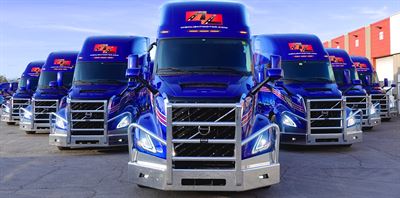
Volvo Trucks has delivered an order of 125 all-new VNL 860 long-haul tractors to Highlight Motor Group in Canada, the largest Canadian order to date for the model. The VNL 860 is advertised to deliver up to a 10% fuel-efficiency improvement versus the previous model and includes advanced safety features aimed at driver retention; Highlight refreshes its fleet every four to five years and primarily runs Volvo equipment. While supportive of incremental sales and product adoption in North America, the 125-unit order is modest relative to Volvo Trucks’ ~134,000 global deliveries in 2024 and is unlikely to materially move Volvo Group fundamentals on its own.
Market Structure: The 125-unit VNL order is strategically significant as a signal rather than a revenue event (125/134,000 2024 deliveries ≈ 0.09%). It underscores fleet-owner preference for a 10% fuel-efficiency gain and advanced safety (driver retention premium), implying OEMs that deliver measurable TCO improvements can sustain pricing power and residual-value premiums in North America over the next 3–5 years. Risk Assessment: Near-term market impact is immaterial (days–weeks) but medium-term (quarters) exposure includes freight-cycle risk, supply-chain bottlenecks, and accelerating regulation toward ZEVs that could strand diesel-heavy investments within 5–10 years. Tail risks include sudden North American clean-truck subsidies/mandates or diesel price spikes that flip economics; monitor Class 8 order flow, EPA/state rule changes, and diesel futures weekly for 90 days. Trade Implications: Tactical alpha can be extracted by favoring OEMs/suppliers with strong North American penetration and proven TCO improvements (Volvo Group VOLV-B.ST, Paccar PCAR, Cummins CMI) and by using structured options to cap downside while capturing cyclical order momentum over 3–12 months. Also consider relative-value trades that long fuel-efficient OEMs and short peers with weaker product cycles or higher capex risk to electrify. Contrarian Angles: Consensus may underweight the resale-value uplift and driver-recruitment premium from safety/comfort features; conversely, it may overrate the durability of diesel demand given tightening emissions policy. A mispricing opportunity exists between OEMs that can monetize TCO gains now versus those facing higher retrofit/electrification capex later — this trade plays out over 6–36 months.
AI-powered research, real-time alerts, and portfolio analytics for institutional investors.
Overall Sentiment
mildly positive
Sentiment Score
0.35
