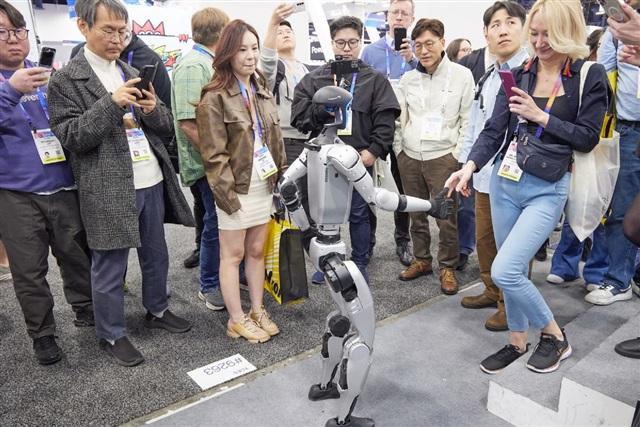
Humanoid robots are moving beyond pilot programs into early commercial deployments as developers press for real-world use, with industry participants saying initial adoption will be concentrated in a limited set of sectors. For investors, this indicates the emergence of a nascent commercial market that could drive revenue for robotics and AI vendors, but adoption risks and sector concentration warrant cautious, targeted exposure rather than broad bullish allocations.
Market structure: Early commercial humanoid adoption will concentrate in logistics, warehousing, and repetitive light-industrial work where ROI per unit could exceed $50k–$150k annually; winners are chipmakers (NVDA), industrial automation (TER, ABB, ROK) and cloud/AI integrators (MSFT, AMZN), while staffing firms (MAN, RHI) and low-margin retail operators see gradual demand substitution. Pricing power shifts to component suppliers (sensors, actuators) if unit volumes stay constrained—expect 10–30% component margin premium in the first 12–24 months. Risk assessment: Tail risks include regulatory/safety bans or high-profile accidents that pause rollouts (low probability, high impact), major chip shortages that delay deployment (3–9 months), or macro capex pullbacks in a recession (6–18 months). Hidden dependencies: battery density, specialized motors, software integration services and cloud GPUs; a single supplier constraint could stall programs and spike component prices 20–50%. Key catalysts are Q2–Q4 2026 pilot-to-contract announcements, government industrial subsidies, and NVDA/TER earnings commentary on order backlog. Trade implications: Prefer diversified incumbents over pure-play humanoid startups: establish tactical 1–3% longs in NVDA and TER + 1–2% in ABB/MSFT over a 12–36 month horizon; use 6–12 month call spreads to capture defined upside while capping IV risk (target +30–50% upside). Relative trades: long automation integrators vs short staffing (MAN/RHI) to capture structural substitution; add on pullbacks of 5–10% or after confirmed commercial rollout announcements. Contrarian angles: Consensus underestimates slow revenue conversion—historical industrial-robot adoption took decades, not quarters—so pure-play valuations are likely premature; expect 12–24 months of noisy milestones before steady revenue. Unintended consequences include increased maintenance/service as recurring revenue—favor companies with service ecosystems. If a clean commercial win >$100M is announced, pivot to scale positions quickly within 30 days.
AI-powered research, real-time alerts, and portfolio analytics for institutional investors.
Request DemoOverall Sentiment
mildly positive
Sentiment Score
0.25
