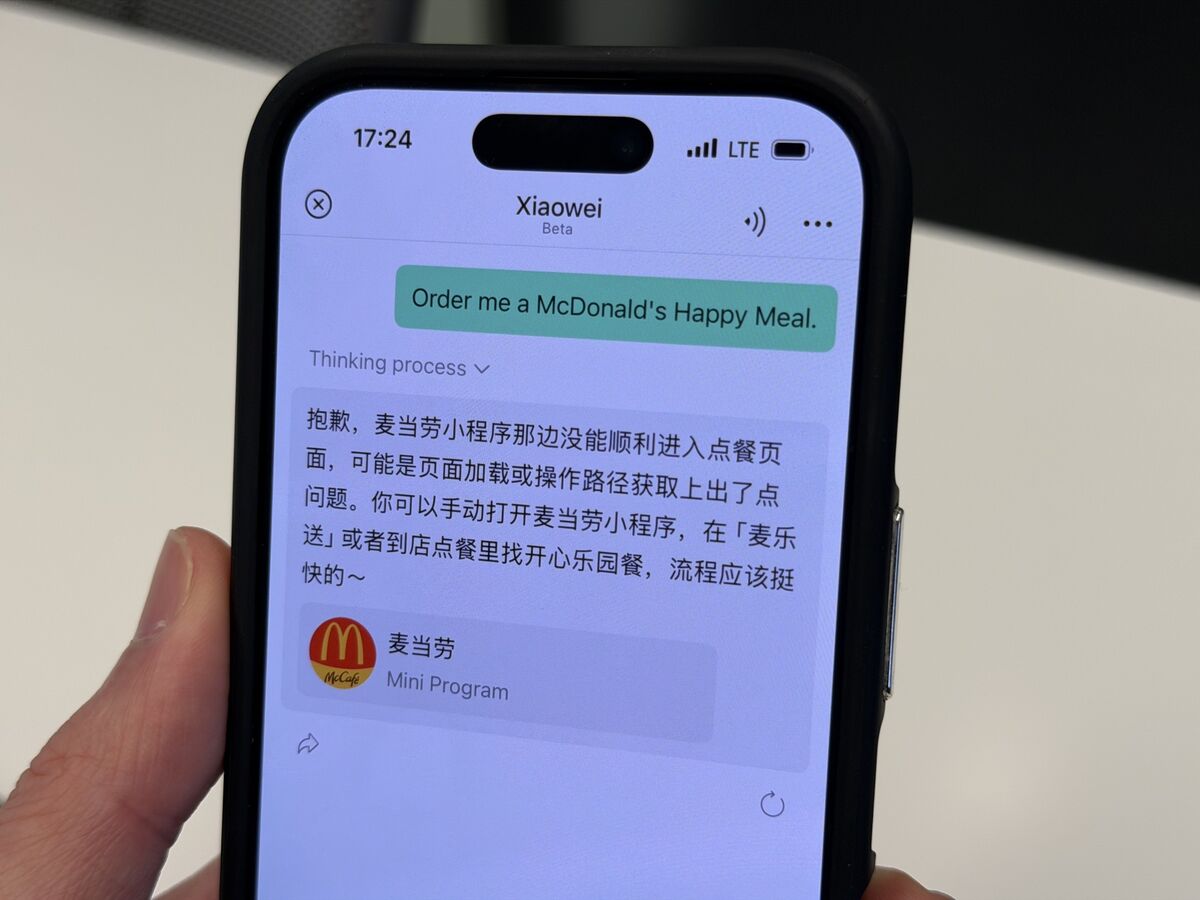
Tencent began letting select users test an internal WeChat AI agent (“Xiaowei”) in June, aiming to turn WeChat into an AI-enabled super-app that can eventually run errands for over 1B users. The effort targets reputational and competitive pressure, as Tencent has fallen behind in frontier AI model development versus peers like Alibaba and ByteDance. While still a prototype rollout, it signals a strategic push to close the AI gap and improve Tencent’s positioning in China’s app ecosystem.
Tencent’s edge here is not model quality; it is user context. If an AI layer sits inside the primary consumer operating system for payments, messaging, and mini-app discovery, the monetization path is faster than for standalone chatbots because Tencent can convert intent into transactions with far fewer steps and better attribution. That makes the first derivative effect more important than frontier-model benchmarks: higher session frequency, better ad targeting, and a potential lift in mini-program commerce take-rate. The structural winner is TCEHY, while the most obvious loser is any platform whose growth depends on users leaving WeChat to search, browse, or transact elsewhere.
The second-order effect is on competitive distribution, not just AI spend. Alibaba can still win on merchant tooling and cloud infrastructure, but it is disadvantaged if consumer intent remains trapped inside WeChat; that lowers the value of external traffic acquisition and makes it harder to build a comparable super-app loop. Over 1-3 months, the key catalyst is whether Tencent shows evidence of meaningful retention/engagement lift rather than a demo effect; over 6-18 months, the real question is whether the agent becomes a default transaction layer or stays a novelty constrained by safety, payment permissions, and regulatory friction.
Contrarian view: the market may overprice the strategic significance of a prototype while underpricing execution risk. A conversational interface can also compress ad inventory and cannibalize existing engagement surfaces before it creates new monetization, so the near-term P&L impact may lag sentiment. The thesis is falsified if Tencent cannot show incremental time spent, mini-program conversions, or ad ROAS improvement by the next few quarters, or if Alibaba’s AI-enabled cloud and commerce stack starts taking share in consumer workflows instead of losing it.
AI-powered research, real-time alerts, and portfolio analytics for institutional investors.
Request DemoOverall Sentiment
mildly positive
Sentiment Score
0.25
Ticker Sentiment
