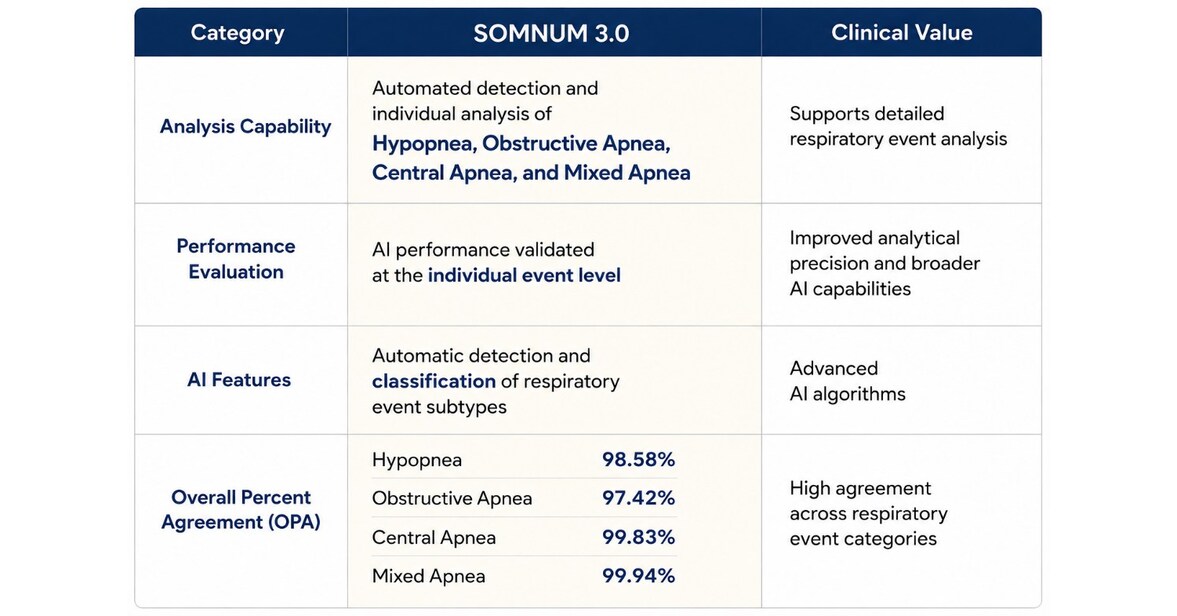
HoneyNaps announced FDA 510(k) clearance (K253390) for SOMNUM V3.0, expanding its AI software for polysomnography (PSG) sleep-disordered breathing analysis. The update adds automated apnea/hypopnea detection and subtype classification into OSA, CSA, and MSA, with validation showing Overall Percent Agreement (OPA) of >97% across respiratory event categories. The company plans additional 510(k) clearances for future SOMNUM versions and further development of next-generation digital biomarkers (Hypoxic Burden, Arousal Burden, Ventilatory Burden).
This is a regulatory de-risking event, not yet a revenue event. For a sleep-diagnostics software name, FDA clearance mainly changes the probability of getting purchased by U.S. labs and hospital networks; it does not solve workflow integration, reimbursement, or the long sales cycle that usually gates enterprise adoption. The market often overprices the first U.S. clearance because it looks like a commercialization milestone, when the real test is whether it converts into recurring seat licenses, per-study fees, or OEM distribution agreements.
Second-order, better automated scoring can expand throughput at sleep labs by lowering technician bottlenecks, which is mildly positive for downstream therapy vendors if more OSA cases are formally identified. That said, the biggest economic winner is likely not the software vendor itself but the incumbent platform with the largest installed base and the best distribution into labs and DMEs. If this technology is broadly adopted, it can also commoditize routine scoring and pressure smaller service bureaus that monetize manual interpretation.
The contrarian risk is that the headline clears a technical hurdle while leaving commercial friction untouched: integration into PSG systems, local validation, and payer acceptance can take quarters. The move is likely overdone if the stock rerates on “AI + FDA” without evidence of signed U.S. deployments. Watch for contract announcements, revenue disclosure, and any additional 510(k) cadence over the next 1-3 months; the 6-18 month thesis only works if the company proves it can turn regulatory validation into a repeatable distribution engine.
AI-powered research, real-time alerts, and portfolio analytics for institutional investors.
Overall Sentiment
strongly positive
Sentiment Score
0.45
Ticker Sentiment
