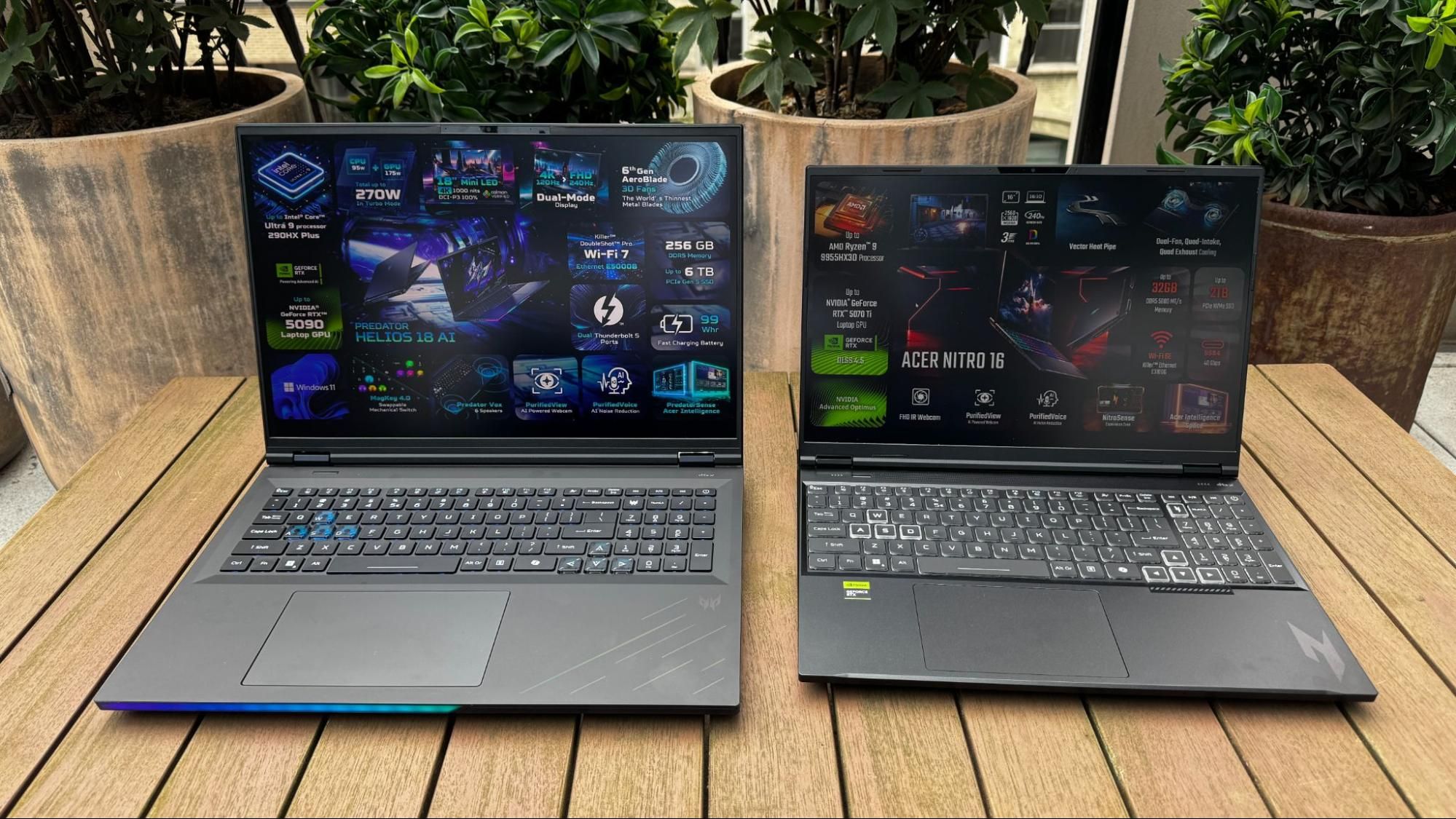
Acer unveiled multiple new products at Computex 2026, led by the Predator Helios 18 AI with up to an Intel Core Ultra 9 290HX Plus, RTX 5090 mobile GPU, 256GB DDR5, and 6TB of storage across three PCIe 5.0 NVMe slots. The refreshed Nitro 16 pairs AMD Ryzen 9 9955HX/9955HX3D options with up to an RTX 5070 Ti and 32GB DDR5-5600, while Acer also introduced the streaming-only Nitro Blaze Link handheld, an 8,000 Hz Aethon 750 TKL keyboard, and a travel backpack with USB-C charging passthrough. Pricing and availability were not disclosed, making the news primarily a product showcase with limited near-term market impact.
Acer’s split strategy is more important than the individual product specs: it is effectively broadening Nvidia’s and AMD’s exposure across two different demand pools. The halo 18-inch design is a near-term ASP amplifier for Nvidia mobile, while the more “sensible” 16-inch AMD configuration could drive higher unit volume if Acer’s value positioning resonates; that mix is incrementally supportive for both NVDA and AMD, but with different time horizons. The biggest second-order winner may be the ecosystem around premium laptop components—high-end panels, storage, and connectivity silicon—because these systems are increasingly sold as “platform bundles” rather than just CPUs/GPUs.
For Intel, the risk is less about one launch and more about brand placement at the top of the stack being contested. If Nvidia’s flagship mobile SKU continues to monopolize the ultra-premium narrative while AMD captures the better price/performance story, Intel gets squeezed into the middle where OEM differentiation is weakest and discounting pressure is highest. That matters over months, not days: even if volumes are modest, repeated flagship placements shape channel preference and can influence design wins in the next refresh cycle.
The streaming-only handheld is a subtle tell on where OEMs see margin durability: low-compute, accessory-like devices can be monetized without taking meaningful silicon risk. That’s bearish for standalone handheld compute incumbents if this category gets reframed as a network accessory rather than a device class. The contrarian view is that the market may be underestimating how much of the announced lineup is actually a supply-chain story—premium laptops need lots of memory, storage, Wi-Fi, and power management parts, and that bill-of-materials intensity can matter more to suppliers than headline GPU counts.
AI-powered research, real-time alerts, and portfolio analytics for institutional investors.
Request DemoOverall Sentiment
mildly positive
Sentiment Score
0.20
Ticker Sentiment
