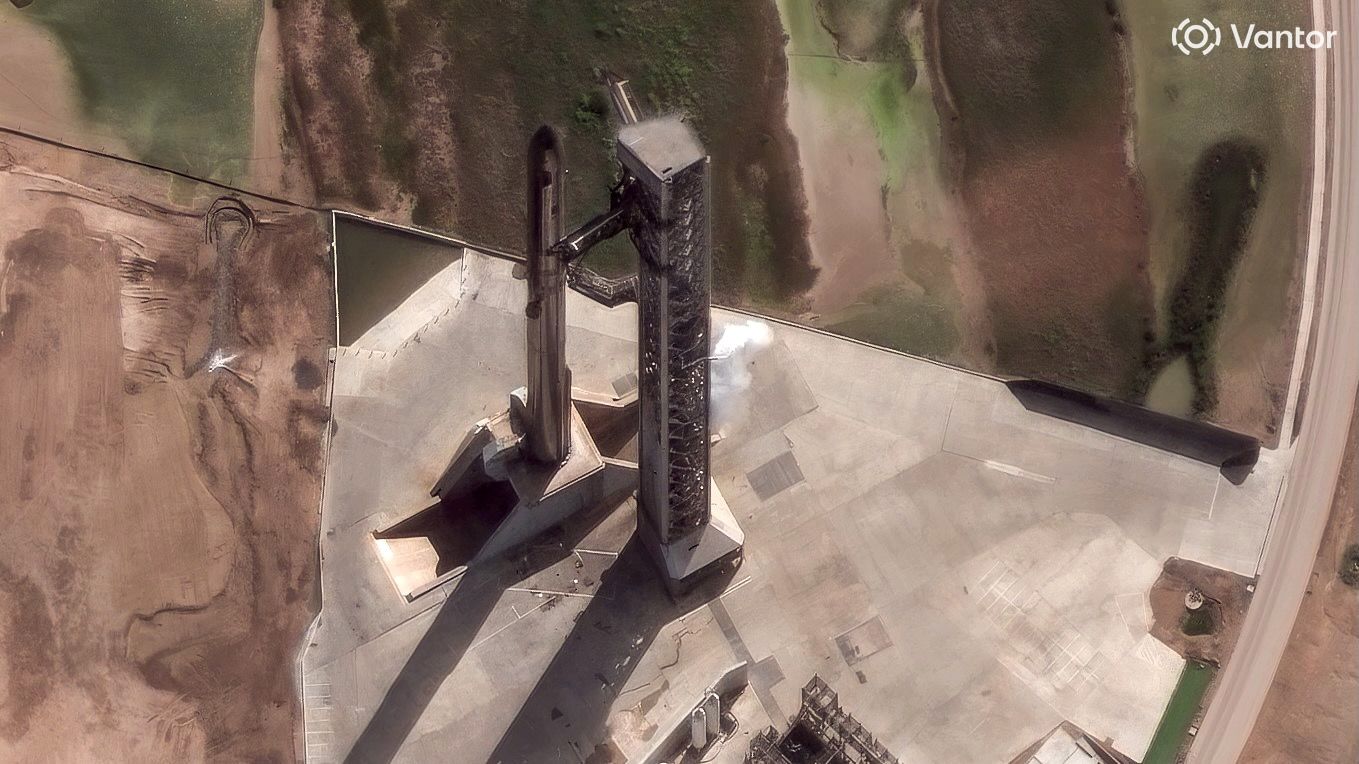
SpaceX’s first Starship V3 launch attempt was scrubbed after late-countdown technical issues, and the company is now targeting a liftoff on May 22 in a 90-minute window opening at 6:30 p.m. EDT. The article highlights a satellite photo of the 408-foot rocket on the pad and notes that Starship V3 is intended to move the program toward operational flights and future Artemis moon missions. The news is largely factual and operational, with limited immediate market impact.
The immediate market signal is not the launch delay itself; it is that Starship has crossed from “engineering spectacle” into a repeatable data-generating asset. That matters because the next leg of value creation in commercial space will accrue less to headline launch providers and more to the enabling stack: earth-observation, tracking, telemetry, optical/thermal components, and mission software. A higher cadence Starship program increases the addressable market for satellite operators that need frequent replenishment, while also pressuring incumbent launch economics over the medium term as payload-to-orbit costs reset lower.
The more interesting second-order effect is on defense procurement and dual-use infrastructure. If Starship V3 continues to mature, the U.S. strategic logic shifts toward larger, cheaper, faster constellation refresh cycles, which is bullish for vendors that support distributed space architectures and resilient comms. But it is bearish for any program whose moat depends on scarce launch capacity or high launch prices; the competitive gap narrows first in commercial and then in government bidding, with a lag of roughly 6-18 months as contracts reprice.
Consensus likely underestimates how binary the setup remains in the near term. Over the next few days, launch outcome drives sentiment; over the next few quarters, the key catalyst is not whether Starship launches once, but whether it demonstrates a credible cadence and payload reliability curve. A clean flight would likely re-rate the whole space ecosystem, while another technical scrub or anomaly would reinforce the market’s view that operational economics remain aspirational rather than investable.
The contrarian view is that the satellite imagery itself is a reminder that the most durable monetization may sit one layer above the rocket. Observability, tasking, and analytics businesses can compound even if launch headlines stay volatile, because the growth in space assets expands monitoring demand regardless of which launcher wins. In other words, the market may be over-focusing on SpaceX’s milestone and underpricing the picks-and-shovels beneficiaries of a larger, more data-rich orbital economy.
AI-powered research, real-time alerts, and portfolio analytics for institutional investors.
Request DemoOverall Sentiment
neutral
Sentiment Score
0.08
