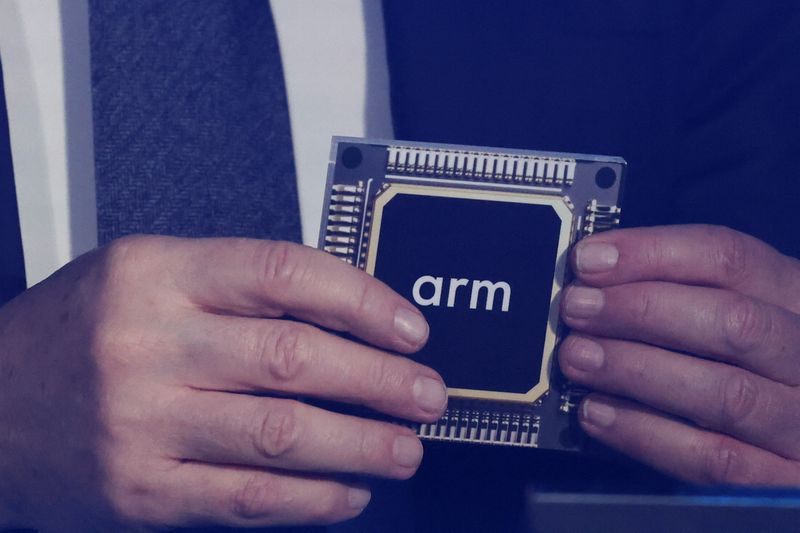
Arm reported fiscal Q4 2026 adjusted EPS of 60 cents on revenue of $1.49 billion, both ahead of consensus for 58 cents and $1.47 billion. Licensing revenue rose 29% year over year to $819 million and royalty revenue increased 11% to $671 million, while Q1 fiscal 2027 guidance of $1.26 billion in revenue was roughly in line with estimates. Shares initially surged as much as 13% after hours on strong AI demand for the new Arm AGI CPU, but reversed after management said supply has only been secured for the first $1 billion of more than $2 billion in customer demand.
The market is telling us the key issue is no longer demand, but conversion of design wins into manufacturable volume. That is a positive for ARM structurally because it validates AI inference CPUs as a real budget line in the data center stack, but it also means near-term upside is gated by foundry allocation, advanced packaging, and customer qualification cycles rather than headline TAM alone. In other words, ARM’s revenue mix can improve for years, while the stock can still de-rate whenever execution shifts from narrative to supply constraints.
Second-order winners are the incumbent CPU ecosystem players that get the same secular tailwind without the same balance-sheet and manufacturing transition risk. If hyperscalers accelerate Arm-based server adoption, the pressure lands on x86 incumbency, not just at the socket level but across software optimization, power efficiency procurement, and fleet refresh budgets. Intel is the more direct strategic loser, but AMD also faces a subtle risk: if ARM captures more inference workloads, the market may start assigning more of the AI server growth pool to CPU attach rather than GPU attach, which could slow the multiple expansion premium in the broader semi complex.
The overhang for ARM is that the stock has effectively become a supply-chain sentiment vehicle: every incremental proof point on demand can be offset by a reminder that capacity, not interest, is the bottleneck. That makes the next 1-2 quarters prone to sharp mean reversion on any comment about lead times, customer readiness, or revenue recognition pacing. The contrarian view is that the selloff may be too harsh if investors are extrapolating a near-term miss into a multi-year demand problem; the real risk is timing slippage, not thesis failure.
For QCOM, AAPL, MSFT, GOOGL, and META, the signal is that ARM architecture is becoming even more entrenched across endpoints and hyperscale infrastructure, which should modestly reinforce their bargaining power versus legacy CPU vendors and improve fleet efficiency over time. The more important implication is for capex allocation: if AI inference economics keep favoring lower-power CPUs, hyperscalers may rebalance spend toward broader server refreshes rather than only incremental GPU buys, which supports a wider set of semi and infrastructure beneficiaries over the next 12-18 months.
AI-powered research, real-time alerts, and portfolio analytics for institutional investors.
Request DemoOverall Sentiment
mildly positive
Sentiment Score
0.45
Ticker Sentiment
