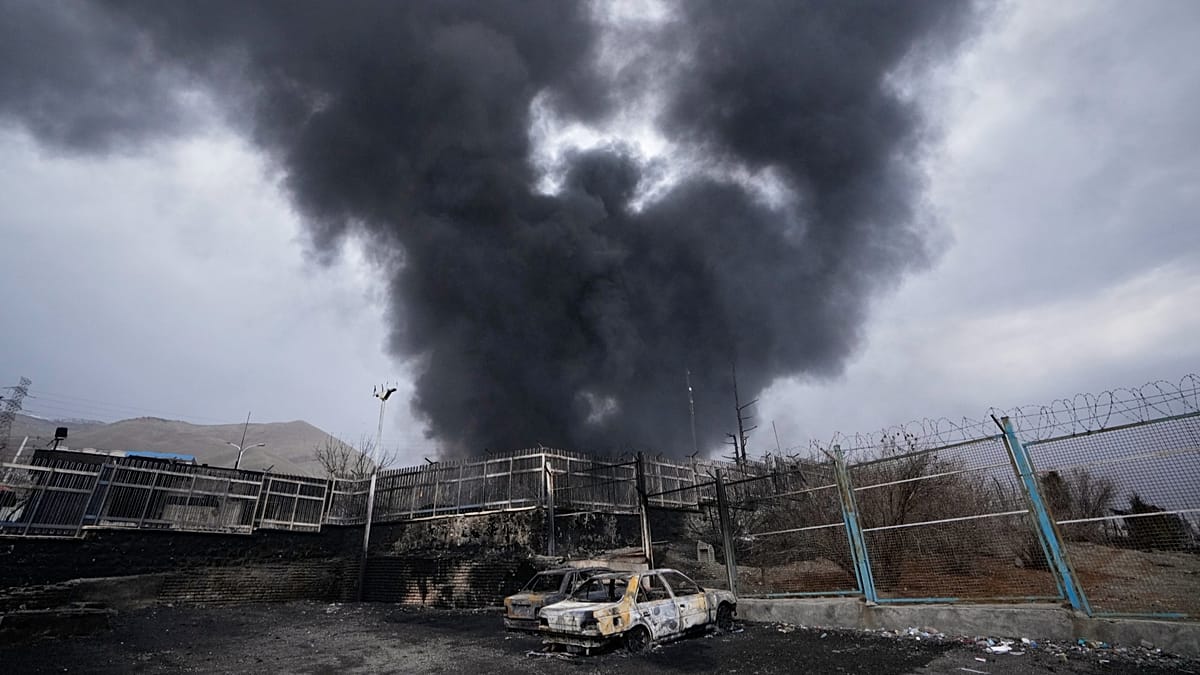
Iran launched barrages of drones and missiles targeting Saudi Arabia, Kuwait and Israel, escalating a regional conflict that could threaten shipping through the Strait of Hormuz and global energy flows. European gas benchmark TTF fell ~15% after US signals the war could end “very soon,” but Aramco warned of “catastrophic consequences” if disruptions persist; Aramco reported 2025 profits of $104.7bn, down ~5.5% from $110bn in 2024 and expects its 7.0m bpd East–West pipeline to reach capacity in days. Energy market stress is already prompting policy and price responses: Egypt hiked fuel by up to ~17% and the Egyptian pound weakened to ~52/USD, while G7 ministers are discussing releases from strategic oil reserves.
Regional chokepoint risk is now a persistent supply-shock tail rather than a one-off spike; logistics re-routing (longer voyages, terminal congestion) can add a structural premium to crude and refined product spreads that compounds over 4–12 weeks. Expect tanker repositioning and higher War Risk/STR insurance to add roughly $1–3/bbl to delivered crude costs in the near term, squeezing refiners with tight feedstock access and fattening upstream free cash flow where export outlets remain available.
Defense and aerospace order books are the underpriced convexity: procurement cycles mean booked revenues and backlog expansions materialize over 6–24 months, not days, creating a multi-quarter earnings uplift even if kinetic intensity normalizes. The most direct gamma comes from air-defence interceptors, long-range munitions and sustainment spares — supply-chain lead times (components, semiconductors, precision machining) make near-term revenue stickier than markets expect.
Macro cross-currents favour safe-haven assets and commodity-rich balance sheets: persistent energy-premia supports sovereign exporters’ FX but stresses importers and fiscal deficits in EM, keeping downward pressure on local currencies and driving central-bank intervention. A credible diplomatic pathway or coordinated SPR release are the high-probability de-riskers that would unwind energy and FX dislocations within 2–8 weeks; absent that, elevated volatility should persist and feed into higher forward implied vols in energy and defense sectors.
Key catalytic monitors: Brent and regional freight/insurance indicators (S&P Global Insurance Indices, Baltic Dirty Tanker Index) over next 30 days; NATO procurement announcements and tendering flows over 3–9 months; any coordinated SPR release or clear diplomatic communiqué — these move the trade from tactical to structural.
AI-powered research, real-time alerts, and portfolio analytics for institutional investors.
Request DemoOverall Sentiment
strongly negative
Sentiment Score
-0.70
