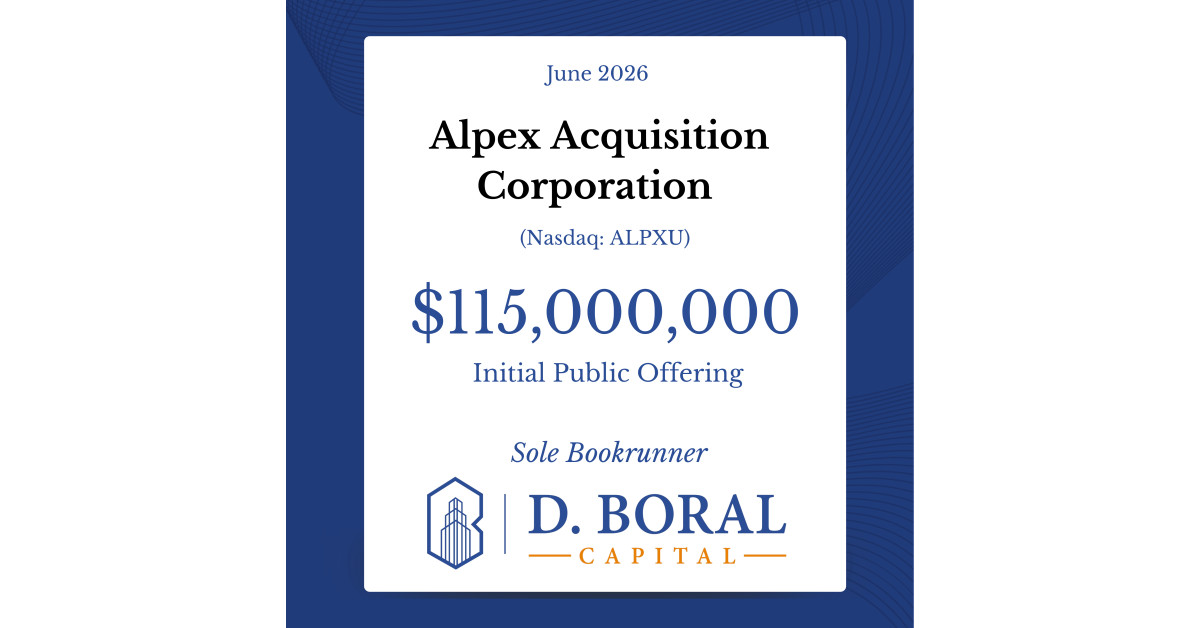
Alpex Acquisition Corporation (NASDAQ: ALPXU) closed its IPO of 11.5M units at $10.00 per unit, including full over-allotment, raising $115.0M gross proceeds and starting Nasdaq trading on June 25, 2026. It also completed a $1.88M private placement (187,500 units at $10.00) and placed $115.0M of the net IPO proceeds into trust for a future business combination. Units are structured as one Class A share plus a $11.50 warrant and a right to receive additional shares upon an initial business combination.
This is a flow signal more than a fundamental one: a new SPAC printing and upsizing suggests speculative capital is still available for blank-check structures, which tends to help the underwriting ecosystem and nearby SPAC IPO pipeline more than the specific vehicle. The first-order beneficiaries are the banks and event-driven desks that can monetize the spread; the real competitive effect is on other capital-seeking microcaps, because fresh SPAC supply competes for the same risk budget and can temporarily crowd out lower-quality listed names.
For the security itself, the economic center of gravity shifts after the IPO: near-term pricing is usually anchored by trust value and arb desks, while the warrants/rights embed upside that only matters if the eventual target is high-growth and the sponsor can avoid a value-destructive deal. The key second-order risk is that a weak acquisition either gets punished at announcement or leaks value through dilution, extensions, and redemptions; the market will care far more about merger quality and redemption rates than the IPO close.
Catalysts are on a 1-3 month horizon for target rumor/leak dynamics, but the real tradeable event is 6-18 months out when a business combination must justify the structure. What would falsify any constructive view is a hot-money breakdown in SPACs broadly: widening bid/ask in units, weak warrant pricing, or a sharp drop in new deal volume after rates move up or a few bad merger votes hit. TGT is effectively a non-factor here unless broader consumer-risk sentiment is being used as a decoy read on the tape, which looks weak.
Contrarian view: the market may be over-reading a routine SPAC launch as evidence of a healthier IPO window. In practice, the signal is mixed—SPAC issuance can rise precisely when traditional IPO quality is poor, because sponsors need a financing wrapper that tolerates more dilution and less disclosure discipline than a vanilla IPO.
AI-powered research, real-time alerts, and portfolio analytics for institutional investors.
Request DemoOverall Sentiment
mildly positive
Sentiment Score
0.18
Ticker Sentiment
