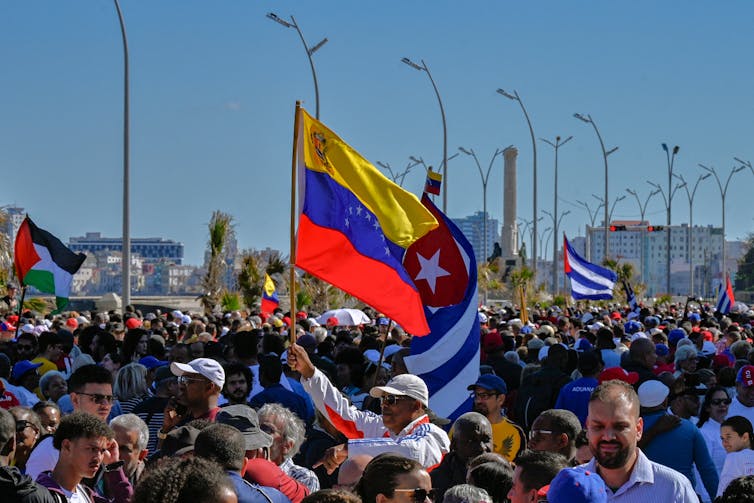
The seizure of Venezuelan President Nicolás Maduro on Jan. 3, 2026 and the Trump administration's stated intent to bar Venezuelan oil shipments to Cuba mark a deliberate shift toward 'maximum pressure' aimed at provoking regime change in Havana. Cuba's economy has contracted sharply—GDP down about 11% since 2020—with currency weakness, widespread shortages and increased emigration (reported at more than 1 million, possibly closer to 2 million), while Venezuela reportedly contributed roughly US$60 billion to Cuba from 2002–2022. For investors, the immediate implications are heightened geopolitical risk in the region, potential disruptions to subsidized oil flows that may worsen Cuba's energy and humanitarian crisis, pressure on the Cuban peso and elevated political instability that could affect regional trade, migration flows and selective commodity/energy market sentiment.
Market structure: The immediate winners are U.S. national-security suppliers (LMT, RTX, NOC), reinsurers and regional refined-product suppliers who can capture displaced Venezuelan/Cuban flows; losers are Cuban importers, clandestine Venezuelan oil traders and nearby island fuel markets that may see localized crack-spread widening. Competitive dynamics favor compliant Western firms and insurance markets—sanctions raise barriers and pricing power for sanctioned-compliant middlemen; displacement of gray-market barrels will shift regional refining margins rather than global crude balances (likely <100k b/d effect). Cross-asset: expect a stronger USD, wider EM sovereign spreads, higher gold and oil volatility, and short-term Treasury demand (TLT up) as risk premia reset.
Risk assessment: Tail risks include kinetic escalation in Cuba or wider Caribbean (low-probability, high-impact), a refugee wave >100k over 3 months stressing U.S. municipal services, or retaliatory cyber/energy shocks from Russia/Iran. Time horizons separate into immediate days (volatility spike across FX, oil, credit), short-term weeks/months (EM bond/FX stress and outflows), and long-term quarters (structural re-routing of oil trade and regime instability). Hidden dependencies: clandestine Venezuelan oil routes, Russian/Cuban military ties, and remittance flows; catalysts are formal U.S. sanctions on oil transfers, asset seizures, or a large public protest/ crackdown in Cuba.
Trade implications: Defensive longs (defense primes, gold) and tactical shorts of EM credit are preferred—buy GLD and select call spreads on LMT/RTX for 6–12 months; short EMB (iShares J.P. Morgan USD EM Bond ETF) for a 3–6 month play while funding with a small TLT long. Options: buy volatility via gold and oil straddles if near-term headline risk persists; avoid large directional long crude positions unless supply disruption >200k b/d persists. Sector rotation: reduce Latin America consumer/bank cyclicals, increase allocation to defense, reinsurance and high-quality sovereign debt.
Contrarian angles: The market may overprice a sustained crude supply shock—historical Iran/Libya episodes show spikes often fade in 2–6 months as trade routes adapt; similarly, defense stocks can be volatile and already priced for a geopolitical premium. Unintended consequences include a nationalist backlash in Cuba that prolongs instability and raises insurance/shipping costs—favor pay-for-time option structures over outright leveraged equity exposure and size positions conservatively (1–3% portfolio each).
AI-powered research, real-time alerts, and portfolio analytics for institutional investors.
Request DemoOverall Sentiment
moderately negative
Sentiment Score
-0.35
