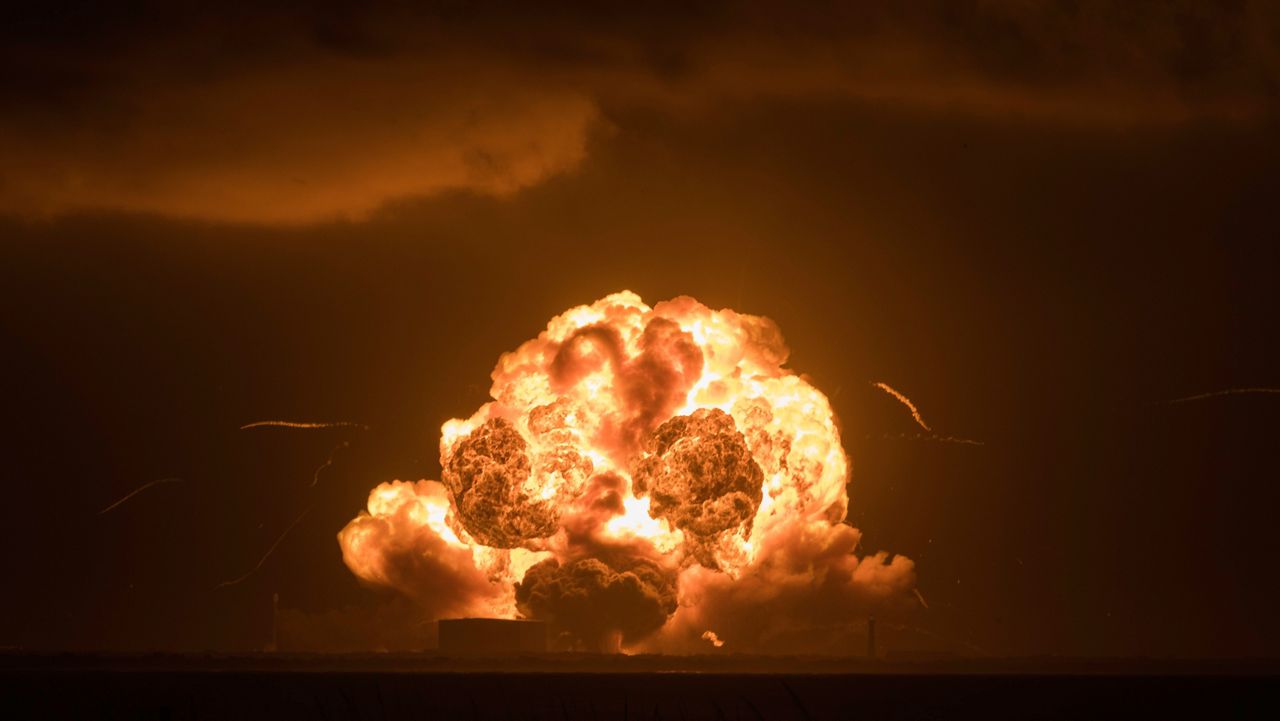
Blue Origin’s New Glenn exploded during a static fire test at Launch Complex 36, severely damaging the launch pad and threatening the timeline for Artemis III. An expert said SpaceX’s Falcon Heavy could potentially launch Blue Origin’s Blue Moon lunar lander, but that would require engineering changes and NASA approval. The incident also comes as SpaceX’s Starship is grounded, raising a meaningful risk of delay to the Artemis III mission slated for 2027.
This is less a one-off engineering event than a schedule risk cascade across a tightly synchronized government-backed launch stack. When a reusable launch complex goes dark, the bottleneck is not just pad reconstruction; it is requalification, range availability, insurance reset, and supplier reprioritization, which can push recovery from months into multiple quarters. The immediate market implication is that Artemis milestones become more path-dependent on alternate launchers and more exposed to any single-point-of-failure in the mission architecture.
The second-order winner is SpaceX’s broader launch infrastructure franchise, but the benefit is asymmetric: Falcon Heavy is more likely to gain as a contingency path than as a permanent substitute, while Starship’s own grounding undermines its role as the long-term moon logistics backbone. That creates a subtle near-term advantage for legacy, proven launch systems and for contractors whose value lies in qualification data, integration work, and schedule insurance rather than raw headline capability. Companies tied to independent heavy-lift capacity, mission assurance, and pad rebuild services should see incremental demand.
The contrarian point is that the market may overestimate the probability that NASA simply swaps rockets. Interface changes for a lunar lander are not trivial, and any workaround imposes mass, trajectory, and thermal constraints that can reduce payload margins or add validation time. So the right trade is not a blanket bearish view on lunar space names; it is a relative-value bet that schedule risk rises faster than funding risk, with the most vulnerable names being those whose valuation depends on flawless execution over the next 12 months.
AI-powered research, real-time alerts, and portfolio analytics for institutional investors.
Overall Sentiment
moderately negative
Sentiment Score
-0.45
