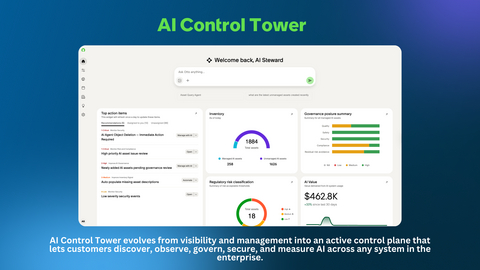
ServiceNow expanded its AI Control Tower with new governance, observability, security, and cost-management capabilities across enterprise AI systems, agents, and workflows. The company also deepened integrations with AWS, Microsoft, NVIDIA, Anthropic, and OpenAI, while announcing new AI agents and voice-focused workflow features. Customer references highlighted adoption gains, including Rolls-Royce reporting nearly tripled adoption, 38,000 tickets deflected, and a 34% reduction in resolution times.
ServiceNow is trying to reprice itself from workflow software to the control plane for enterprise AI, and that matters because governance is becoming the budget-holder’s way of saying “yes” to broader deployment. The second-order effect is that every incremental AI rollout inside a customer now pulls more spend toward NOW’s platform layer, while making point solutions for monitoring, approvals, and access control easier to displace. That creates a longer-duration monetization path than classic seat expansion: once AI becomes operationally embedded, switching costs rise not just from data gravity but from risk ownership.
The near-term read-through is more mixed for the ecosystem. AMZN, MSFT, NVDA, SAP, ORCL, and WDAY all benefit if ServiceNow’s control tower becomes a standard overlay across hyperscalers and enterprise apps, but they also face a subtle compression of their own AI feature differentiation as governance is abstracted upward. The most vulnerable are the voice/contact-center names (NICE, FIVN, TWLO), because ServiceNow is moving intelligence into the workflow rather than the standalone communication layer; if voice becomes a native action surface inside enterprise systems, vendors that depend on a separate front end risk lower attach and pricing power.
The biggest contrarian risk is that this is still mostly a trust/ops sale, not a pure consumption inflection. Enterprises like the story now, but broad budget release depends on proving ROI within 1-2 quarters of deployment; if measured savings lag, the platform can revert to an “insurance” purchase with slower expansion. Also, the governance pitch could backfire if regulators standardize external compliance tooling, reducing the moat of integrated controls and turning this into a feature battle rather than a platform expansion.
The timing matters: this should support NOW over the next 3-6 months into the rollout window, but the real catalyst is not launch headlines—it is evidence of higher net retention, larger deal sizes, and faster AI module attach in the next two earnings cycles. If those metrics do not inflect, the stock likely gives back the multiple expansion before year-end.
AI-powered research, real-time alerts, and portfolio analytics for institutional investors.
Request DemoOverall Sentiment
moderately positive
Sentiment Score
0.60
Ticker Sentiment
