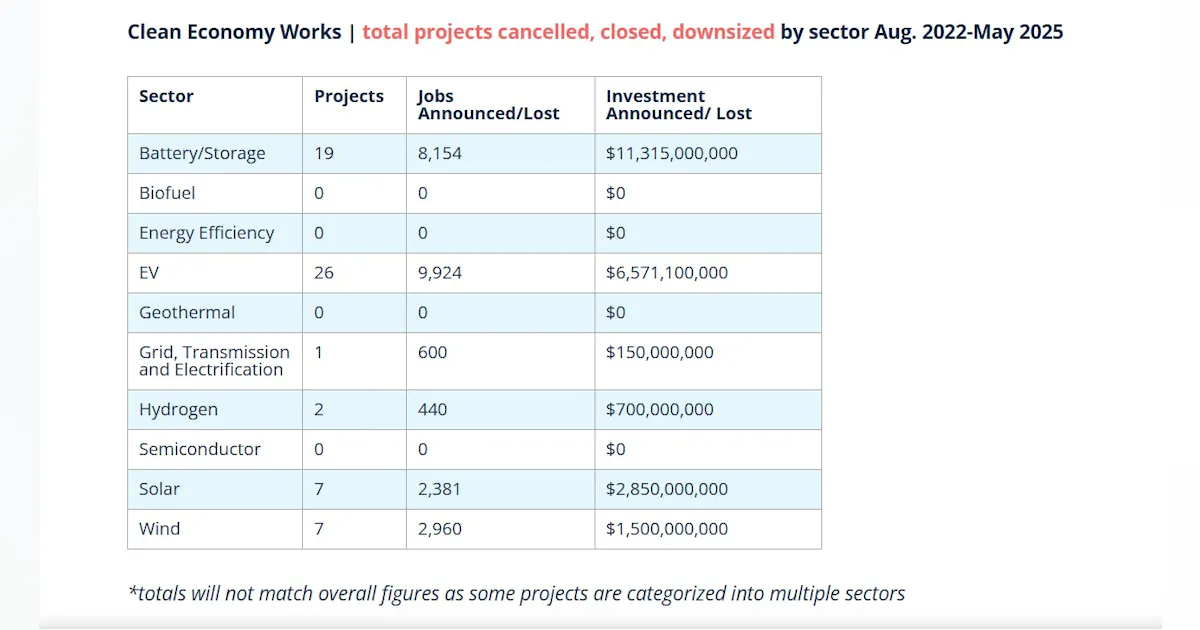
U.S. businesses canceled $1.4 billion in new clean energy and factory projects in May, bringing the year-to-date total to $15.5 billion in abandoned investments and nearly 12,000 lost jobs, largely due to policy uncertainty and anticipated tax increases on clean energy credits from a pending Senate bill. This trend, which includes GM shifting an EV factory plan to gas vehicle production, is seen as a direct reaction to potential rollbacks of tax incentives that previously drove an American clean energy manufacturing boom. Analysts warn these cancellations could lead to higher electricity prices for consumers and businesses, with significant economic impact, particularly in Republican congressional districts, despite some smaller new investments announced concurrently.
Mounting policy uncertainty is actively derailing capital investment in the U.S. clean energy sector, with businesses canceling $1.4 billion in factory and energy projects in May alone, bringing the year-to-date total to $15.5 billion. This trend is directly linked to a pending Senate bill aimed at increasing taxes and rolling back clean energy credits, which had previously spurred significant investment. The impact is tangible, exemplified by General Motors' decision to pivot a planned EV factory in New York to produce 8-cylinder gas vehicles instead. While some new, smaller investments were announced, such as Rivian's $120 million supplier park, they are dwarfed by the scale of the cancellations. The economic repercussions are disproportionately concentrated in Republican congressional districts, which account for over $9 billion of the abandoned projects. Furthermore, analysis suggests that repealing the tax credits could lead to higher energy costs for consumers and businesses, potentially increasing average household utility bills by over $110 annually and business energy costs by at least 10%.
AI-powered research, real-time alerts, and portfolio analytics for institutional investors.
Overall Sentiment
Negative
Sentiment Score
-0.75
Ticker Sentiment
