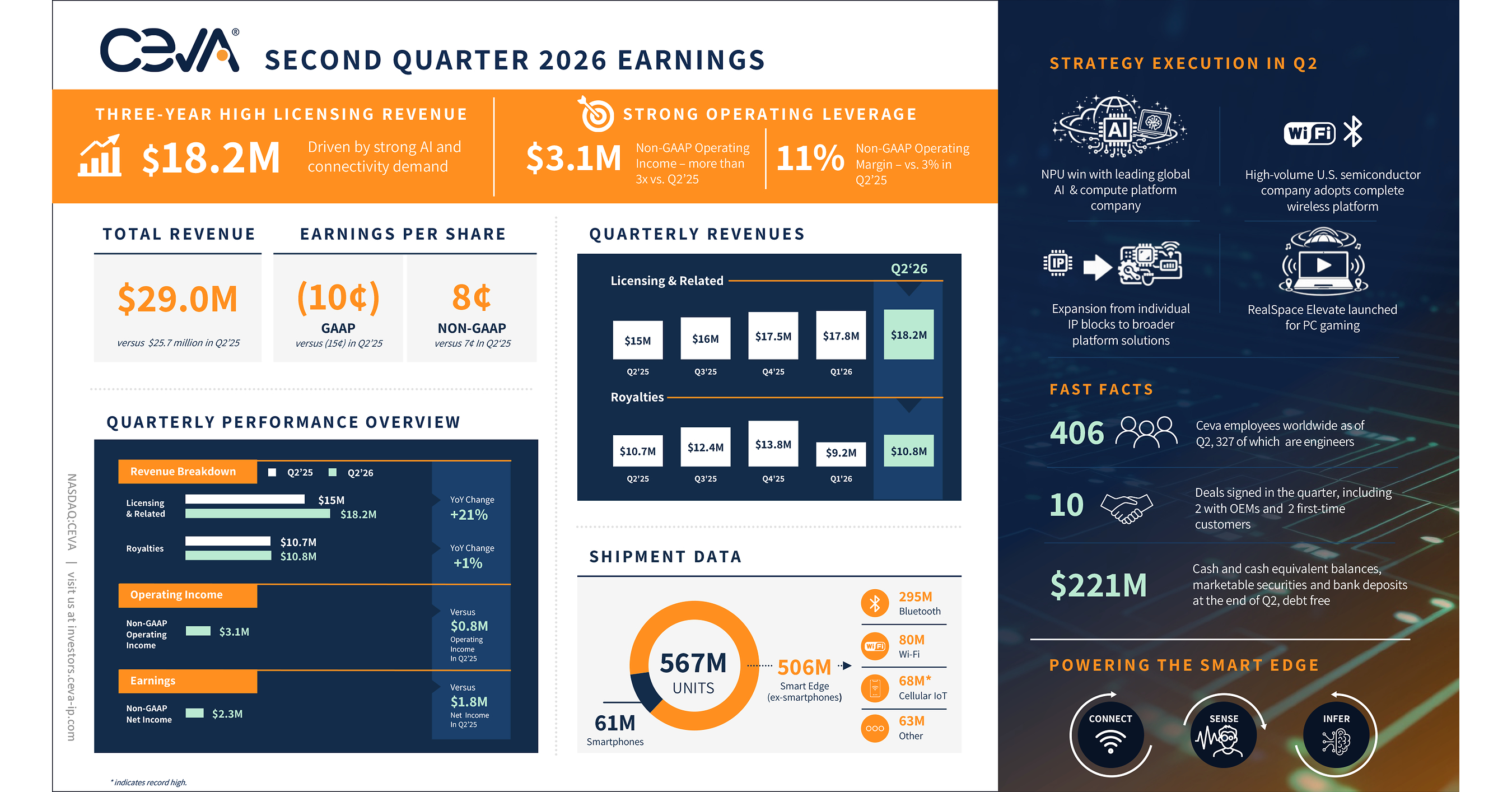
Ceva reported Q2 revenue of $29.0M (+13% YoY), with licensing and related revenues of $18.2M (+21% YoY, highest in three years) and royalties of $10.8M (+1% YoY, +17% sequentially) supported by strong wireless connectivity shipments and ramping automotive AI programs. Non-GAAP operating income rose to $3.1M (vs. $0.8M) and non-GAAP operating margin improved to 11% (from 3%), reflecting operating leverage despite continued GAAP losses. The company also signed 10 IP licensing agreements during the quarter and cited an agreement with a leading global AI/platform company, indicating improving momentum in AI silicon licensing.
The market should treat this as a proof-of-customer-fit event rather than a clean earnings inflection. For a licensing model, the important tell is that deal quality appears to be improving: more first-time and OEM-direct wins usually mean higher content per design and better stickiness, but the monetization lag means the P&L upside is more visible in backlog/unbilled revenue than in next-quarter EPS. That makes CEVA a better story on multi-quarter operating leverage than on a single-quarter beat.
Second-order, the biggest beneficiaries are the broader AI silicon ecosystem and platform companies trying to outsource blocks of the stack instead of building everything in-house. If large compute or OS-controlled customers keep buying external NPU and connectivity IP, it reinforces the value of modular design and compresses the advantage of smaller point-solution IP vendors; by contrast, companies with broader IP portfolios and ecosystem reach should capture share. The direct loser is any handset/connectivity supplier still dependent on commodity hardware content, because CEVA’s improving royalty mix suggests more of the value pool is moving upstream into IP.
The key risk is timing: licensing can look strong for 1-2 quarters before royalty cadence validates it 2-4 quarters later. If royalties do not accelerate into the next two reporting periods, the stock will likely revert to a low-growth IP multiple despite the AI narrative. Falsifiers are straightforward: a reversal in licensing momentum, flat-to-down sequential royalties, or customer concentration that shows the quarter was driven by a handful of one-off wins rather than a broader design-win cycle.
AI-powered research, real-time alerts, and portfolio analytics for institutional investors.
Request DemoOverall Sentiment
moderately positive
Sentiment Score
0.62
Ticker Sentiment
