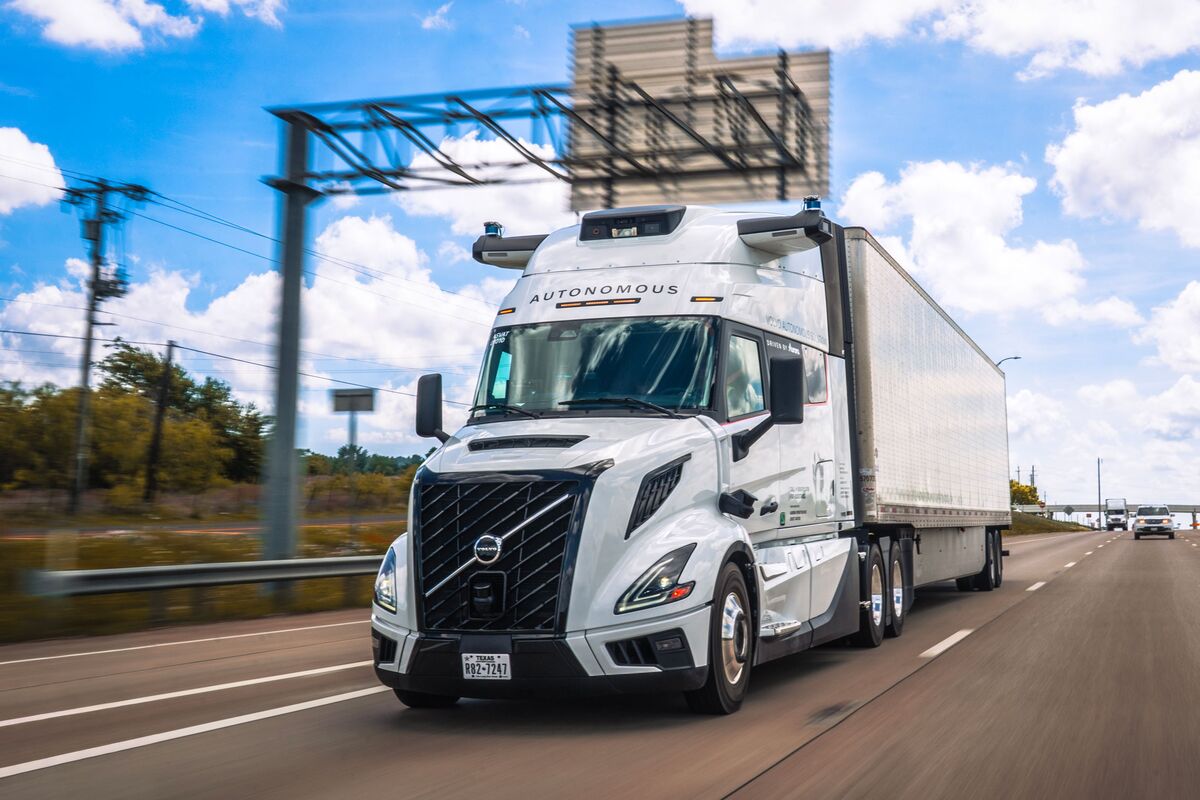
Volvo AB expects autonomous transportation revenue to approach $3 billion within five years, with driverless US highway operations starting in the first quarter and more than 300 autonomous rigs expected by end-2027. The outlook signals a sizable commercial ramp in self-driving trucking, supporting Volvo’s growth narrative. The announcement is positive for Volvo and the broader autonomous freight ecosystem, though it is still an execution-dependent multi-year plan.
This is less a revenue announcement than a signal that autonomy is moving from pilot economics to network economics. If Volvo can credibly scale to a few hundred rigs, the value pool shifts from selling trucks to monetizing utilization, software, and uptime — which usually carries far better gross margin and higher multiple potential than cyclical OEM revenue. The market will likely start valuing the autonomous stack as a separate annuity-like business line, especially if early US highway miles show lower insurance and fuel/maintenance cost per mile.
The first-order losers are likely traditional freight operators and any OEMs without a credible autonomy roadmap, but the second-order pressure is on incumbent logistics software and telematics vendors whose pricing power weakens if OEM-integrated autonomy becomes the operating system of the fleet. A successful deployment also compresses the premium for contracted long-haul capacity: higher truck utilization means more effective supply, which can cap rate inflation even if freight demand improves. That makes this mildly negative for asset-heavy trucking names and for parts of the trailer/service ecosystem that benefit from scarcity.
The key risk is not technical demo failure; it is deployment friction. The real gating items are regulatory variance by state, liability allocation after a high-profile incident, and whether highway-only autonomy can sustain real-world uptime through weather, construction, and dispatch edge cases over a 6-18 month burn-in period. If early ops are clean, the catalyst expands from “story” to “benchmark,” but a single adverse accident could delay fleet expansion and compress enthusiasm for years.
Consensus is probably underestimating the pace at which capital will reprice around autonomous freight optionality once the first revenue is visible. However, it may also be overestimating near-term economics: the first 300 units are more likely to be strategic proof points than meaningful EPS contributors, so the stock reaction can outrun fundamental impact. The cleaner trade is not a blind long on the OEM, but selective exposure to beneficiaries of higher autonomy penetration and lower exposure to the companies whose valuation depends on constrained freight supply.
AI-powered research, real-time alerts, and portfolio analytics for institutional investors.
Request DemoOverall Sentiment
moderately positive
Sentiment Score
0.55
