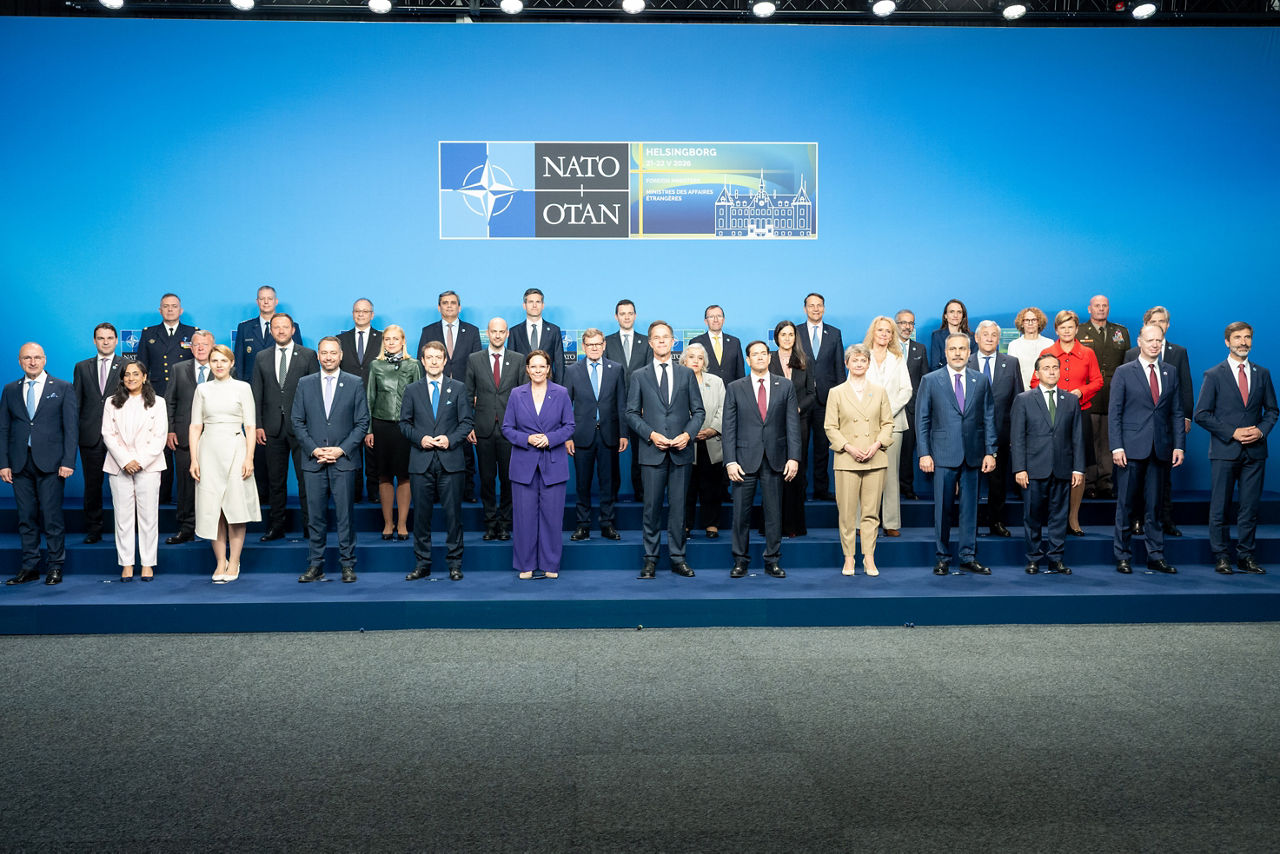
NATO Foreign Ministers met in Helsingborg on 22 May 2026 to prepare for the July summit in Ankara, with the main focus on higher defence spending, stronger industrial production, and continued support for Ukraine. Secretary General Mark Rutte said Allies are charting a path to 5% defence investment and need to turn commitments into concrete results. The meeting also highlighted concerns over Iran’s threat to Strait of Hormuz shipping and broader security risks, but the article is largely policy-focused rather than market-moving.
The actionable read-through is not the headline rhetoric, but the likely normalization of European defense budgets from political promises into multi-year procurement visibility. That favors prime contractors with backlog leverage and domestic European supply chains more than pure-play budget beneficiaries; the market tends to underappreciate that margin uplift often comes with a 12–24 month lag as contract awards convert into production, so near-term winners are the industrials with installed capacity and bottleneck exposure in munitions, air defense, and electronic warfare.
A second-order effect is on suppliers of inputs and manufacturing automation. If allied spending shifts from troop expenses toward hard equipment and industrial base expansion, the largest incremental profit pools can sit in metals, energetics, machine tools, and test/measurement rather than the headline primes, especially where capacity is already tight and lead times extend. That creates a squeeze dynamic: sustained order books should support price discipline and higher working-capital needs, which is constructive for cash-generative incumbents but can pressure smaller subcontractors with execution risk.
The Ukraine support message lowers the probability of a near-term demand air-pocket for European defense names, but it also raises the odds of intermittent headline risk if the July summit disappoints on actual funding or if fiscal pushback resurfaces in southern Europe. The biggest contrarian mistake is assuming this is a one-day geopolitical pop; the real catalyst stack is budget legislation, procurement cycles, and industrial capacity expansion over the next 6–18 months. If the 5% pathway is watered down, the trade should mean-revert quickly because valuations are already embedding a persistent rearmament regime.
Broader geopolitical risk around energy transit is an additional tailwind for defense budgets because it reinforces the case for strategic autonomy and stockpiling, but it also means defense outperformance should be paired with caution on broad cyclicals if the macro market starts pricing in higher oil and higher fiscal deficits. In short, this is a structural capex theme, not a pure event trade, and the highest-conviction expression is through names with order-book optionality and low reliance on one-off contract timing.
AI-powered research, real-time alerts, and portfolio analytics for institutional investors.
Request DemoOverall Sentiment
neutral
Sentiment Score
0.05
