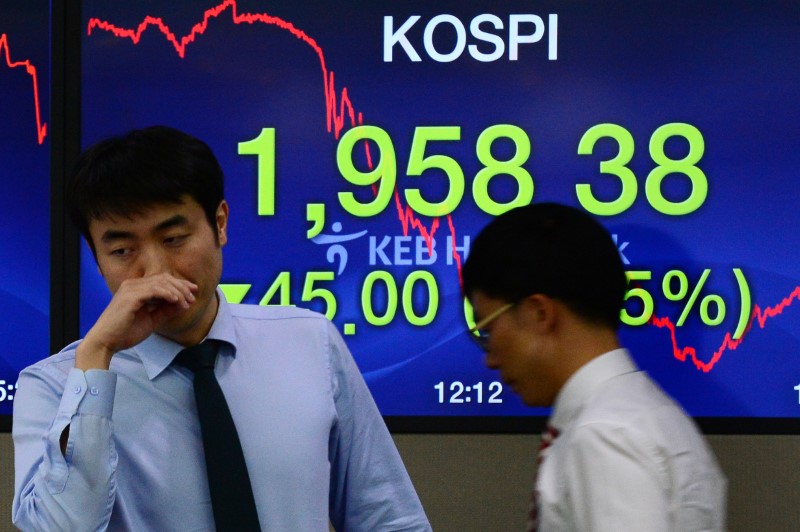
The KOSPI plunged 8.1%, triggering a ~20-minute trading halt, with mega-cap memory names Samsung and SK Hynix down 10–12% and Hyundai Motor off 10.4%. Escalation in the U.S.-Israel war with Iran—Israeli strikes on Iranian oil infrastructure and Iranian missile/drone and ship attacks in the Strait of Hormuz—pushed Brent back to levels seen in early 2022 and threatens ~20% of global oil flows. Markets fear the oil spike will boost inflation and force a more hawkish central bank response, hitting Asian net-oil-importers hard (South Korea sources ~70% of oil from the Middle East). Expect elevated volatility and continued risk-off positioning across regional equities and commodities.
An oil-driven shock in risk assets transmits to developed- and emerging-market equities through two channels: a near-term liquidity/positioning squeeze (days–weeks) as stop-losses and CTAs hit, and a 1–6 month structural margin hit as energy costs feed through to CPI and force central banks to entertain higher terminal rates. Historically, a sustained +$10/bbl Brent shock has translated into roughly +30–50bp of headline CPI in oil-importing Asian economies within 3–6 months, enough to flip a 25bp tightening cadence into an extra 25–50bp of cumulative hikes from the marginal central bank. That combination is particularly toxic for long-duration, cap-ex growth exposures — compressing multiples — while improving cash-flow captures for upstream energy and logistics players.
Second-order winners include refiners, global shipping insurers, and US E&P and LNG names that can convert higher spot realizations quickly; losers extend beyond marquee chip names to energy-intensive parts of the supply chain (fabs, large-scale auto assembly) where opex is sticky and FX moves amplify cost passthrough. For Korea specifically, a weaker KRW cushions exporters on revenue translation but amplifies local-currency input inflation and higher working-capital costs (longer receivable financing, inventory rebuilds), pressuring margins through the next two fiscal quarters. In markets, the immediate reaction will be volatility premium expansion — buying outright puts is expensive; cheaper structural exposure is via calendar spreads or buying protection via skewed put spreads.
A contrarian trigger: if Middle East disruptions remain concentrated on transit/insurance costs rather than physical sustained output loss, oil could mean-revert within 4–8 weeks as spare capacity and strategic releases are deployed; that would force a rapid reversal in rates expectations and a snapback in risk assets. Monitor shipping insurance rates (War Risk S&P), Brent-term structure (spread between prompt and 6-month), KRW basis swaps, and central bank language — any signs of coordination on SPR or diplomatic de-escalation should be treated as a tactical buy signal for oversold cyclicals.
AI-powered research, real-time alerts, and portfolio analytics for institutional investors.
Request DemoOverall Sentiment
strongly negative
Sentiment Score
-0.80
Ticker Sentiment
