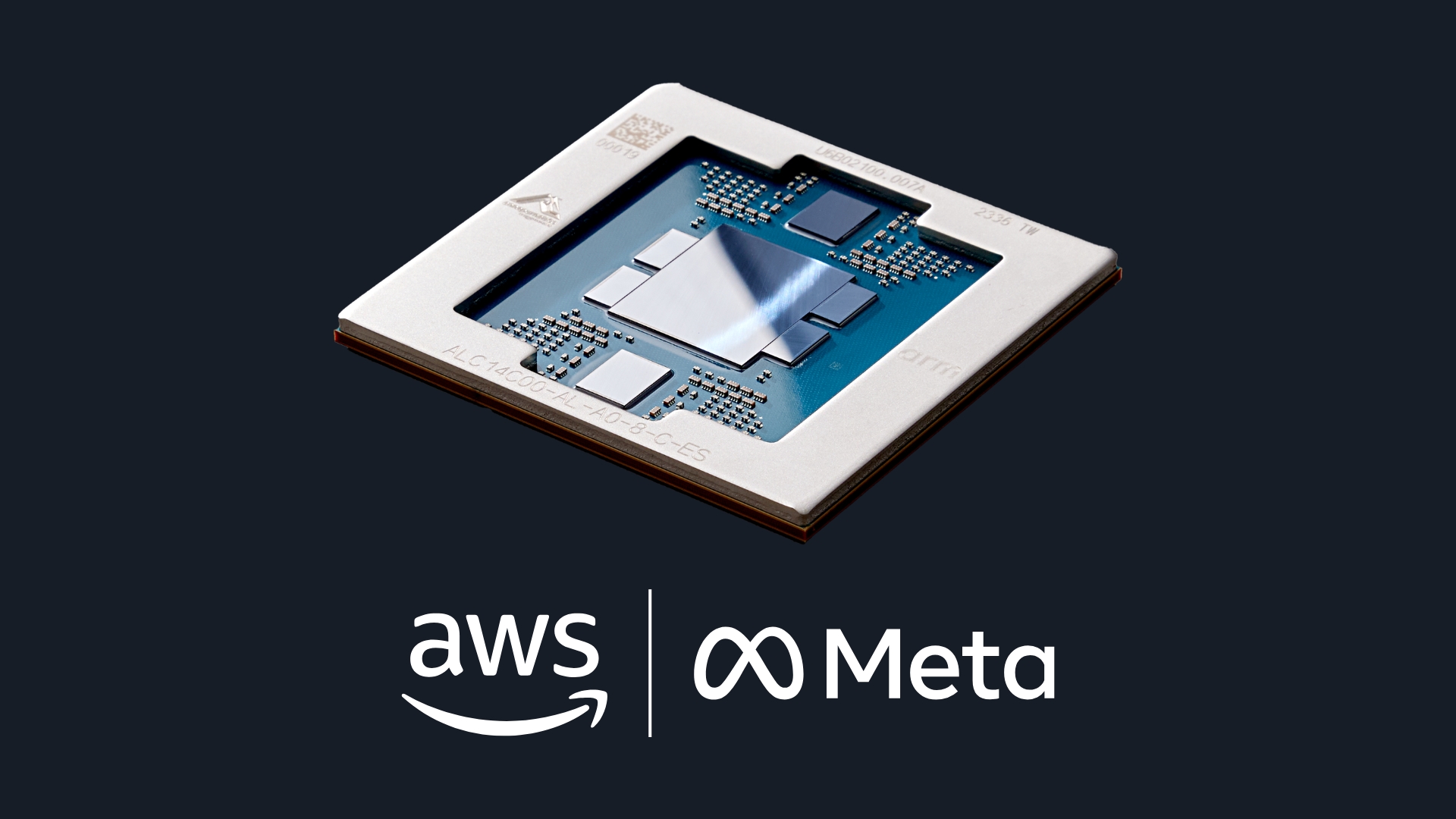
Meta signed an agreement to deploy AWS Graviton processors at scale, starting with tens of millions of Graviton cores and with capacity to expand. The move supports Meta’s next-generation AI and agentic workloads with CPU-focused infrastructure, while AWS says Graviton5 delivers up to 25% better performance, 192 cores, and up to 33% lower communication delays versus the prior generation. The deal strengthens a long-standing Meta-AWS partnership and should be viewed as a positive operational and efficiency upgrade rather than a material near-term financial catalyst.
This is less a headline about Meta buying chips than a signal that the AI bottleneck is shifting from accelerators to the orchestration layer. The market has already priced “more GPUs,” but the underappreciated second-order trade is that large-scale agentic systems consume vast amounts of low-latency CPU, memory, and networking capacity once they move from demo to production. That re-rates the economics of CPU vendors and cloud infrastructure because the marginal workload becomes always-on inference, tool calling, and workflow management rather than sporadic model training.
For AWS, the strategic value is not just silicon margin; it is tenancy expansion and ecosystem lock-in. If Meta standardizes a meaningful portion of its AI stack on Graviton/Nitro/EFA, AWS gains a higher-signal reference customer that can pull adjacent services into the workload path, improving attach rates in storage, networking, and inference APIs. The competitive implication is unfavorable for hyperscalers still dependent on generic x86 economics, because purpose-built silicon plus integrated networking tends to win on total cost of ownership once workloads are large and predictable.
The risk is that the market may over-interpret this as a clean AMZN-positive without factoring in substitution. If Graviton demand accelerates, the incremental beneficiaries may include the broader ARM/CPU ecosystem and networking vendors, while the downside sits with x86 incumbents and any cloud provider whose AI narrative remains GPU-centric. The catalyst horizon is months to years: near term the trade is sentiment and design-win validation; over time the real monetization depends on whether agentic AI traffic actually scales into sustained production rather than remaining pilot-stage. A reversal would come if AI agents stay model-training heavy, or if Meta proves able to optimize the same workloads on cheaper in-house or alternative silicon.
Contrarian read: this is not necessarily a capex expansion story, but a cost-optimization story disguised as AI growth. If that’s right, the market should expect lower unit compute cost per interaction, not necessarily explosive aggregate revenue per workload, which tempers the bullishness on AWS near term. The sharper upside is in proof-of-demand for CPU-intensive AI infrastructure, which could force the broader market to reprice the importance of efficient CPUs and networking relative to GPUs.
AI-powered research, real-time alerts, and portfolio analytics for institutional investors.
Request TrialOverall Sentiment
moderately positive
Sentiment Score
0.52
Ticker Sentiment
