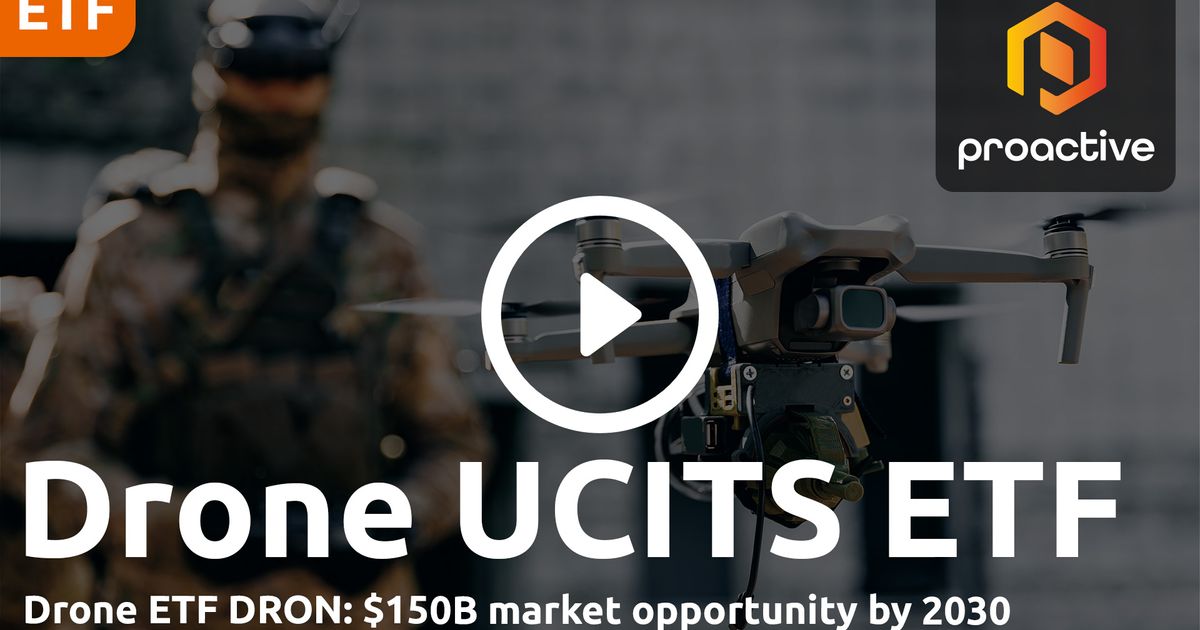
HANetf is highlighting an estimated $150 billion in drone spending from now through 2030, framing drones as a structurally attractive defence and dual-use technology theme. The Drone UCITS ETF (DRON/DRN) uses a pure-play strategy focused on companies where drones are core to the business and includes a mechanism to fast-track new IPOs. The message is positive for thematic defense-tech positioning, but it is commentary rather than a company-specific earnings or policy catalyst.
The investable angle here is not “drones” as a theme, but the acceleration of procurement cycles. In defense, the winner set tends to shift toward firms that can deliver repeatable, software-defined payloads, autonomous navigation, and expendables at scale; that usually favors mid-cap specialists and electronics/sensor suppliers over legacy primes, whose programs are slower, more capital-intensive, and more exposed to bureaucratic delay. The second-order effect is margin dispersion: as drone adoption broadens, value migrates from hardware assembly to components, mission software, and counter-UAS systems, where pricing power is stickier.
The biggest near-term catalyst is budget reallocation rather than headline defense growth. If drone spending rises to the projected scale, expect pressure on traditional armored systems, some manned aviation programs, and lower-priority procurement lines; that creates a relative short on legacy defense basket names with high exposure to platforms being partially substituted by unmanned systems. Supply-chain beneficiaries may include batteries, RF components, imaging, and secure comms vendors, but the fastest earnings upgrades should show up in names with already-validated battlefield use cases and low incremental production cost.
The contrarian risk is that the market is likely underpricing how quickly this becomes commoditized. In commercial use, adoption can look explosive, but unit economics tend to compress once hardware standardizes and competition intensifies; that argues against paying peak thematic multiples for pure-play manufacturers without recurring software or services revenue. The other tail risk is regulatory and export-control friction: a few high-profile incidents can slow civilian adoption, while defense procurement can still be lumpy and politically driven, making the spend curve uneven quarter to quarter.
Overall, this is a better relative-value theme than a blanket long. The cleanest expression is long enablers and countermeasure beneficiaries, short or underweight legacy platforms most vulnerable to substitution, and avoid chasing newly listed pure plays until there is evidence of backlog conversion and gross margin stability.
AI-powered research, real-time alerts, and portfolio analytics for institutional investors.
Request DemoOverall Sentiment
mildly positive
Sentiment Score
0.35
