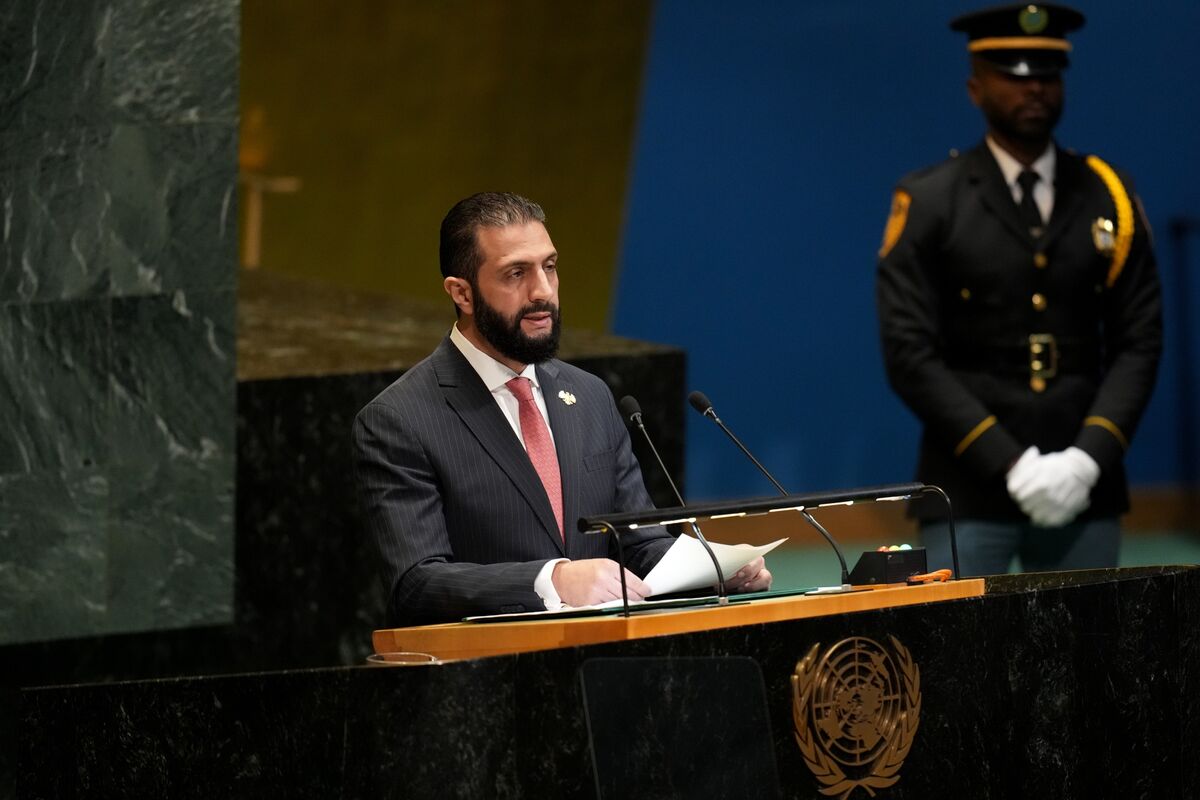
Syria's new leader, Ahmed al-Sharaa, made his debut at the UN General Assembly, marking the first address by a Syrian head of state in over 50 years, where he called for international assistance to rebuild the nation after nearly 15 years of civil war. He asserted that a rehabilitated Syria could contribute to wider Middle East stability, signaling a potential new chapter for the country with implications for regional geopolitics and future reconstruction investment, despite the leader's background as a former al-Qaeda commander.
Syria's new leader, Ahmed al-Sharaa, has made a pivotal diplomatic overture at the United Nations, marking the first address by a Syrian head of state in over half a century. His call for international assistance to rebuild the nation after nearly 15 years of devastating civil war signals a potential turning point for the country and the region. However, this appeal is heavily complicated by al-Sharaa's past as a former al-Qaeda commander, a factor that contributes to the 'strongly negative' sentiment signal (-0.7) and creates significant uncertainty for potential international partners. While the prospect of a large-scale reconstruction effort presents a theoretical opportunity for infrastructure and materials sectors, the high geopolitical risk and the 'uncertain' tone of the situation suggest that securing broad international financial and political backing will be a formidable challenge. The high market impact score (0.7) underscores that developments in Syria, whether toward stabilization or further fragmentation, will have significant implications for regional security and capital flows.
AI-powered research, real-time alerts, and portfolio analytics for institutional investors.
Overall Sentiment
strongly negative
Sentiment Score
-0.70
