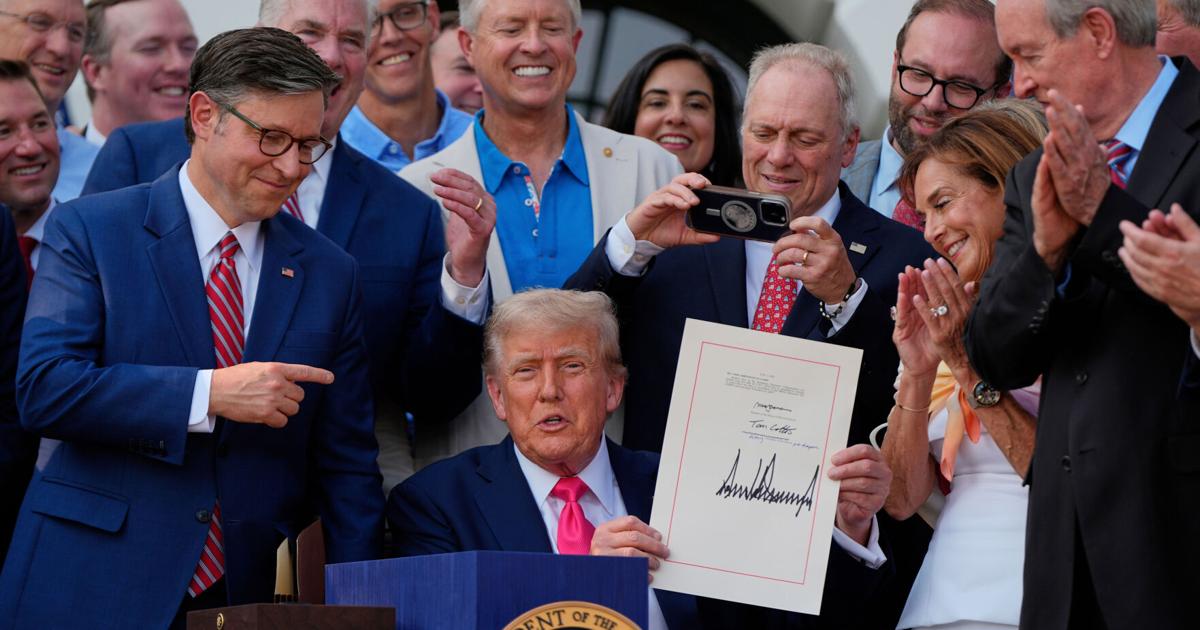
Republicans are using the April 15 tax deadline to promote last year’s tax package, now rebranded as the "Working Families Tax Cuts," highlighting provisions on tips, overtime, and Social Security taxes. The article also notes ongoing political conflict over Medicaid work requirements, a two-month DHS funding shutdown, and a potential $100 billion+ request for military operations against Iran. The piece is primarily about election-year messaging and fiscal policy, with limited direct market impact.
The market implication is not the tax package itself but the political energy deficit it reveals: when a governing party reverts to messaging on prior legislation, forward legislative optionality narrows. That usually favors sectors that benefit from policy stasis rather than new rulemaking — large-cap defensives, utilities, and incumbents with pricing power — while limiting upside in names that depend on fresh federal stimulus, permitting, or targeted industrial policy. The bigger second-order effect is that fiscal bandwidth is being consumed by defense and immigration, increasing the probability that 2026 headlines stay noisy but economically non-transformative. The most important near-term catalyst is the funding fight at DHS and the requested war-related supplemental. If the supplemental advances, it deepens deficit concern without offering an offsetting growth impulse, which is typically a modest headwind to long-duration equities and a tailwind to inflation-protected assets. If it stalls, the administration’s ability to project strength weakens, which raises the odds of policy concessions elsewhere; either way, the path dependence is bad for policy-sensitive cyclicals because the next six to twelve weeks are more likely to produce brinkmanship than clarity. Healthcare is the cleanest relative-value expression because the political debate is shifting from abstract tax policy to concrete coverage risk. Managed care, Medicaid-heavy providers, and hospital operators are likely to trade on headline beta before fundamentals fully adjust, creating a window to buy quality names on fear-driven selloffs if reimbursement risk proves more rhetorical than operational. By contrast, defense and homeland-security contractors may see episodic support from supplemental spending and prolonged agency dysfunction, but the move is already crowded and vulnerable to disappointment if Congress balks at funding growth. Consensus may be underestimating how much the rebranding effort signals message fatigue rather than policy momentum. That makes the tax-cut narrative a weaker midterm catalyst than bulls assume, especially if consumer perception remains anchored to food, health, and debt concerns. The best contrarian read is that the package’s political utility is peaking just as its fiscal cost becomes more visible, so the trade is less about celebrating tax relief and more about positioning for a higher-deficit, lower-visibility policy regime.
AI-powered research, real-time alerts, and portfolio analytics for institutional investors.
Request DemoOverall Sentiment
neutral
Sentiment Score
-0.05
