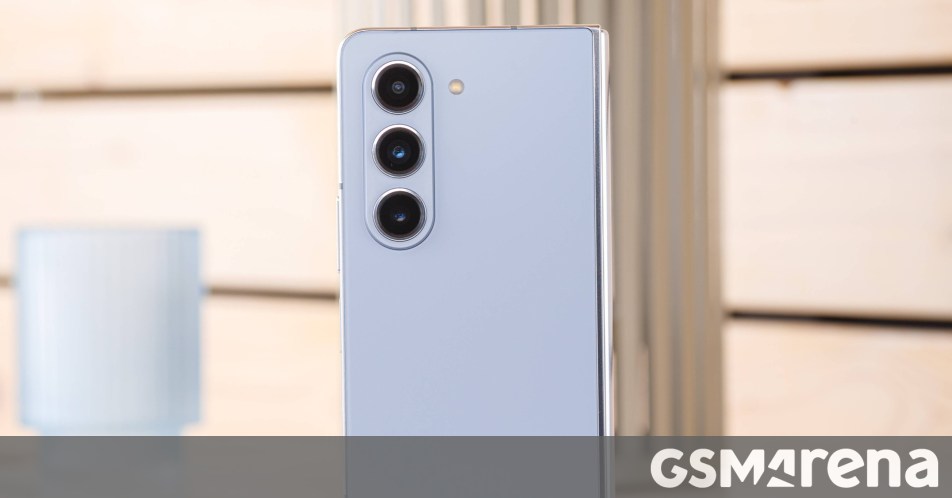
Samsung has expanded the stable One UI 8.5 rollout for the Galaxy Z Fold5 and Galaxy Z Flip5 to India, with firmware versions F946BXXU6GZE2 and F731BXXU6GZE3 respectively. The update had already begun in South Korea last week and is now reaching more regions. This is a routine software update announcement with limited likely market impact.
This is less about one incremental software push and more about Samsung proving it can compress the lag between beta cadence and broad stable deployment on its premium foldable base. That matters because foldables are still a trust product: every successful stable rollout reduces perceived software risk, which supports replacement cycles, lowers return/resubmission friction, and modestly improves attach for services and accessories. The second-order beneficiary is Samsung’s premium ecosystem; the loser is any adjacent Android OEM relying on software inertia rather than hardware differentiation.
For Apple, the read-through is nuanced. A smoother Samsung update pipeline raises the bar on iOS polish expectations, but it also reinforces the value of Apple’s closed-loop advantage: fewer devices, tighter validation, and lower failure dispersion. The market usually treats Android fragmentation as a background issue, but a visible improvement in Samsung’s post-launch support can narrow one of Apple’s traditional qualitative moats at the margin, especially in aspirational markets where foldables and premium Android are gaining share.
The key risk is execution variance over the next few weeks: if the rollout stalls, produces bugs, or triggers forum noise around battery/compatibility, the positive signal reverses quickly and suppresses consumer confidence into the next upgrade window. Over months, the catalyst is whether this pattern extends to future flagships and foldables; a repeated stable-first rollout would indicate Samsung is building a more Apple-like software reputation, while any regression would keep foldables in the “innovative but not fully trusted” bucket.
Consensus likely underweights how much premium device demand is driven by perceived hassle, not specs. If Samsung is quietly improving that experience, it supports mix toward high-end devices and services without needing unit growth to re-accelerate. The market should view this as a small but cumulative strategic positive for Samsung, and only a marginal competitive headwind for Apple rather than a direct threat.
AI-powered research, real-time alerts, and portfolio analytics for institutional investors.
Request DemoOverall Sentiment
neutral
Sentiment Score
0.10
Ticker Sentiment
