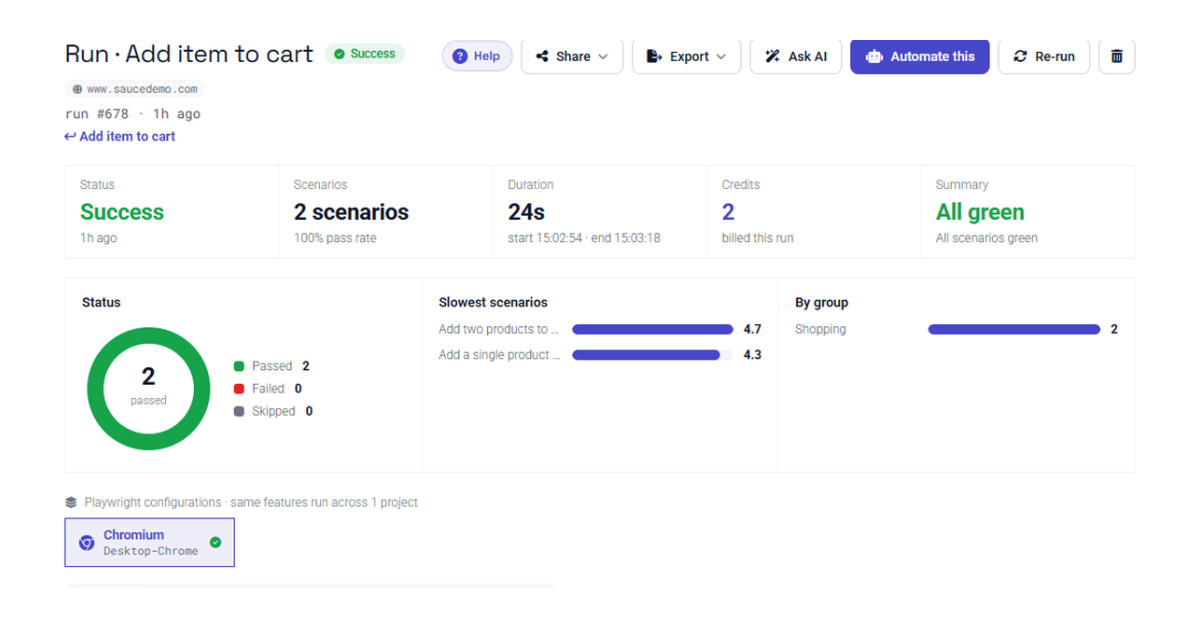
Ice Tea Group launched TestVibe, an AI testing platform (early access) that converts plain-English/Gherkin user journeys into working Playwright code and executes it in isolated cloud sandboxes. The platform aims to reduce flaky tests caused by real-time DOM updates, with generated tests running as standard Playwright versioned in Git and without per-run AI cost. It also adds load testing, live telemetry streaming, and secure tunneling, with a managed cloud option and an air-gapped self-hosted edition.
This is directionally positive for the development-tools stack, but the economic impact is likely too small to matter near term. The real mechanism is not "AI testing" as a feature; it is compression of the cost to author and maintain regression suites, which should modestly increase test coverage and browser-cloud usage while reducing low-end manual QA labor. That is a slow burn, more relevant to enterprise software budgets over 6-18 months than to the next quarter.
The first-order beneficiaries are the underlying platform layers: cloud compute, CI/CD, and browser automation infrastructure. If adoption broadens, usage should accrue disproportionately to Microsoft/GitHub, Azure DevOps ecosystems, and cloud providers that host sandboxed execution, while the pressure falls on niche QA consultancies and outsourced test-maintenance services. The second-order loser is any vendor selling fragile script-authoring or record/replay tooling without a strong enterprise distribution moat; AI-generated Gherkin-to-code lowers switching costs toward the standard Playwright stack.
The main risk is that this remains a demo-friendly workflow rather than a production-grade replacement. In practice, authentication, test-data management, and brittle staging environments are where automation ROI gets lost, so early enthusiasm often overstates the ability to eliminate human QA. If adoption is real, the better sign will be higher CI minutes, browser concurrency, and cloud sandbox consumption rather than press-release traffic.
Contrarian view: the market may underappreciate that the "winner" is not the AI testing app itself but the open, portable artifact it produces. By pushing teams into Gherkin + standard Playwright code stored in Git, the product could entrench the Microsoft-adjacent testing ecosystem and make QA more modular, which is structurally positive for platform leverage but not obviously a standalone equity catalyst today.
AI-powered research, real-time alerts, and portfolio analytics for institutional investors.
Request DemoOverall Sentiment
mildly positive
Sentiment Score
0.15
