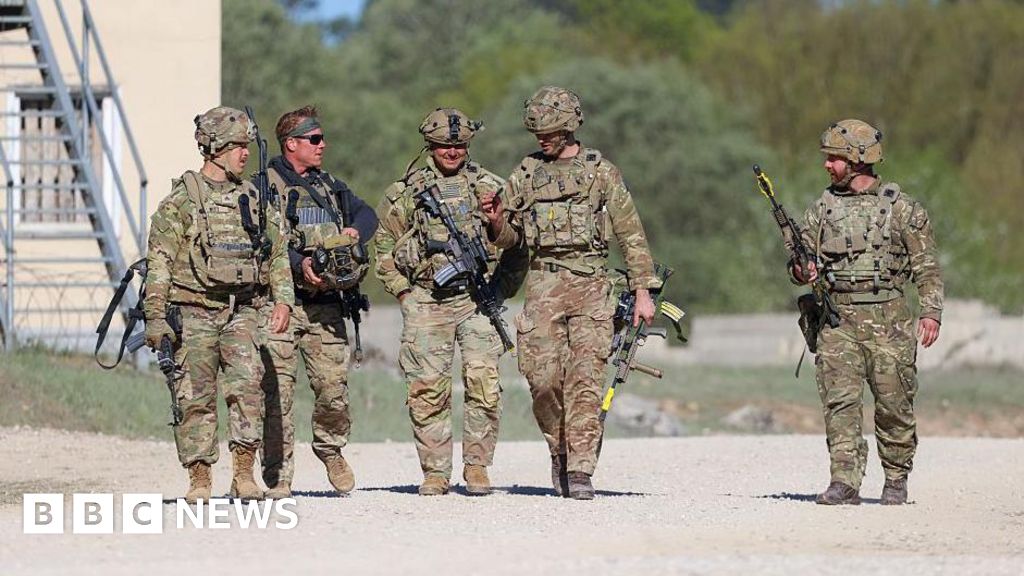
The US plans to withdraw 5,000 troops from Germany over the next 6-12 months, reducing its largest European deployment from more than 36,000 active-duty personnel. The move follows escalating tensions between Trump and German Chancellor Friedrich Merz and raises the prospect of further troop cuts in Italy and Spain. The decision underscores a broader shift in US defense posture away from Europe, with potential implications for NATO cohesion and European security.
This is less about the headline troop count and more about the normalization of sovereign-risk premia across European defense and infrastructure. A forced drawdown from the German hub raises the probability that Europe must fund more readiness, logistics, air defense, and host-nation support locally, which is structurally positive for continental primes, base-construction, transport/logistics, and power-grid resilience names over the next 6-18 months. The immediate market effect is likely modest, but the second-order signal is that U.S. security guarantees are becoming more conditional, which should steepen the policy urgency curve in Berlin, Rome, Madrid, and Warsaw.
The biggest underappreciated beneficiary is not the obvious defense contractor basket, but the infrastructure layer that enables dispersion: runway repair, hardened comms, fuel storage, perimeter security, and distributed energy. If troop reductions force more dispersed basing, demand shifts from a few legacy hubs to a wider set of smaller installations, favoring engineering, electrical equipment, and grid automation vendors. That also creates a tailwind for European domestic defense names with munitions and air-defense exposure, as governments will want visible, politically legible spending rather than abstract alliance commitments.
The risk case is a faster-than-expected de-escalation in the Middle East or a congressional pushback that slows/halves implementation, which would blunt the trade in 1-3 months. Conversely, if Trump extends pressure to Italy and Spain, the market could reprice a broader NATO fragmentation premium and widen U.S.-Europe policy uncertainty into autumn budget negotiations. In that scenario, the catalyst is not the troop withdrawal itself but the fiscal response: procurement acceleration, debt issuance, and multi-year capex commitments that would lift defense and infrastructure order books into 2026.
Consensus may be underestimating how little direct economic damage a smaller U.S. footprint does to Germany versus how much it changes the bargaining position of German fiscal authorities. The move likely strengthens the political case for higher defense outlays and local industrial participation, so the medium-term equity impact can be bullish for selected European defense and industrials even as the headline is risk-off. The right framing is not "Germany weaker," but "Europe forced to internalize more security capex faster than expected."
AI-powered research, real-time alerts, and portfolio analytics for institutional investors.
Request DemoOverall Sentiment
moderately negative
Sentiment Score
-0.45
