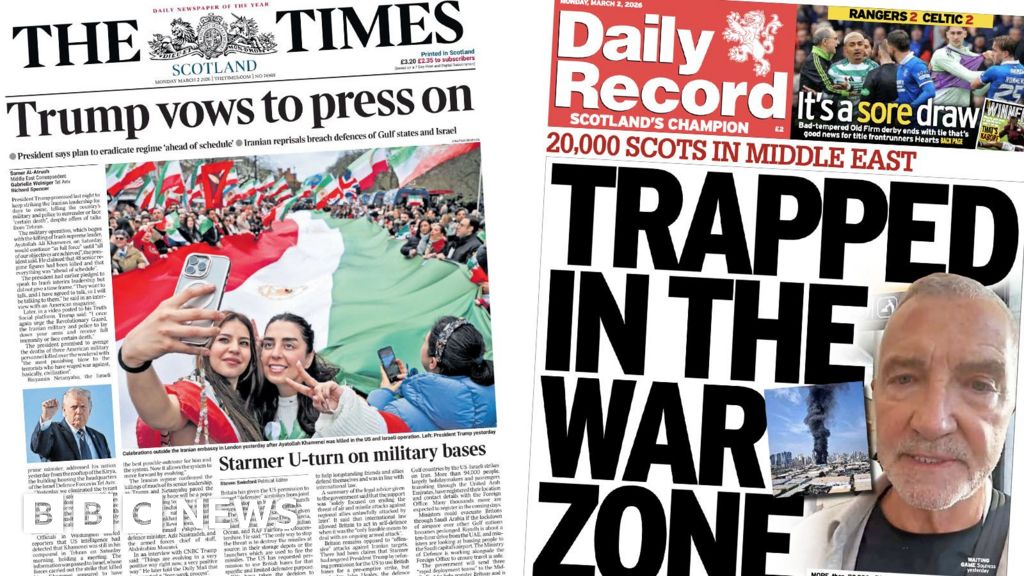
Scottish newspapers report an escalation of conflict centered on Iran and that Scottish nationals are stranded in parts of the Middle East, prompting safety and evacuation concerns. While the brief item provides no financial figures, the story represents a geopolitical shock that could increase risk premia, disrupt regional travel and logistics, and warrant monitoring for knock‑on effects to energy markets, insurance exposures and evacuation-related costs.
Market structure: A military escalation centered on Iran is a clear win for defense primes (LMT, NOC, GD) and war-risk insurers/reinsurers; losers are passenger airlines, leisure (MAR, HLT) and regional travel brokers due to flight cancellations and higher insurance fuel surcharges. Energy markets tilt tighter—Strait of Hormuz disruptions can remove 3–6% of global crude quickly, pushing Brent toward $90–120/bbl within weeks and raising bunker and freight costs, benefiting tanker owners (STNG) and energy majors (XOM, CVX). Cross-asset: expect USD and gold strength, safe-haven sovereign rallies (US/UK/Japan), equity volatility up (VIX +20–50% in first 2–10 trading days) and widening IG/EM credit spreads by 50–150bp if escalation persists.
Risk assessment: Tail risks include a broader regional war or targeted attacks on shipping nodes which could drive oil >$120/bbl and oil-market-induced stagflation, or cyber strikes on ports/airlines impacting operations for months. Immediate (days): liquidity shocks and volatility spikes; short-term (weeks–months): revenue downgrades for airlines/hotels, higher defense orderbacklogs; long-term (quarters–years): re-rating of defense primes and persistent insurance premium normalization. Hidden dependencies: shipping insurance clauses, refinery throughput constraints, and OPEC+ political responses—any coordinated production cut is a force-multiplier. Key catalysts: attacks on merchant vessels, US/UK force deployments, and rapid OPEC supply moves within 7–30 days.
Trade implications: Direct plays: overweight defense primes and energy, underweight airlines/hotels; prefer ETFs XAR (aerospace) and XLE for energy, GLD for gold, and cash-covered puts on LMT to accumulate. Pair trades: long LMT (1–2% portfolio) vs short AAL/UAL (1% each) to capture relative safety; alternatively long STNG vs short MAR if shipping premiums spike. Options: buy 3-month call spreads on XLE (strike spacing to cap cost) and 1–2 month put spreads on AAL/UAL to limit premium outlay; consider buying short-dated VIX calls if volatility is your hedge.
Contrarian angles: Consensus may overpay for defense; if de-escalation occurs within 1–3 months, defense names can mean-revert 10–20%, so size positions at 1–2% and ladder entries. The market may underprice rerouting benefits to near-term LNG and Gulf producers—long positions in UK/ME gas-linked equities could be asymmetric if winter demand surprises. Historical parallels (Gulf crises 1990, 2019 tanker spikes) show oil shocks are fast and mean-reverting within 3–6 months absent sustained supply cuts—set profit targets (15–30%) and stop-losses tight (8–12%).
AI-powered research, real-time alerts, and portfolio analytics for institutional investors.
Request TrialOverall Sentiment
strongly negative
Sentiment Score
-0.60
