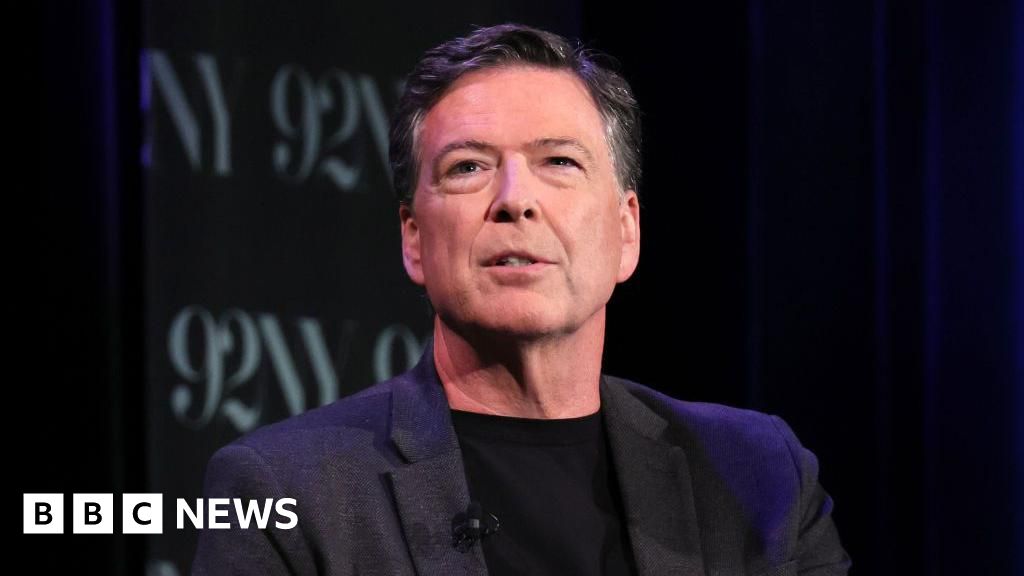
Former FBI Director James Comey has been indicted for a second time, with the new case reportedly tied to an Instagram post showing '86 47,' while the earlier indictment for lying to Congress was dismissed in November over an improperly appointed prosecutor. The article centers on US political and legal developments rather than financial markets. Market impact is likely limited, though the case underscores ongoing legal pressure tied to the Trump administration's political adversaries.
This is less a market event than a governance signal: the incremental risk premium is not about the underlying legal merits, but about the regime shift toward personal enforcement as a policy tool. That raises the expected volatility of institutions exposed to federal discretion—large-cap law firms, media, universities, defense contractors, and regulated sectors with open investigations—because counterparties now have a sharper incentive to assume investigations can be repriced by politics rather than process.
The second-order effect is that enforcement credibility itself becomes a tradable macro variable. If investors conclude appointment/process challenges can be repeatedly cured or reissued, the near-term path is more headlines, more motions, and more discovery risk for anyone tangentially adjacent to the administration’s adversaries; that tends to widen bid/ask on politically sensitive assets and suppress multiple expansion for names whose cash flows depend on regulatory certainty. The bigger risk is not the indictment itself, but spillover into hiring, compliance budgets, and board-level risk aversion across sectors that dislike becoming test cases.
For the base case, the time horizon is days to weeks for headline-driven volatility, with a longer tail over months if the case becomes a proxy for broader executive-power conflict. What could reverse it is either a fast procedural dismissal or a deliberate de-escalation from DOJ, which would compress the risk premium quickly; absent that, every judicial ruling becomes a catalyst for another leg of uncertainty. The contrarian view is that the market may be underpricing how much of this is already known political noise—unless the episode expands into additional prosecutions or agency leadership changes, the durable equity impact could remain narrow and mostly confined to event-driven volatility pockets.
AI-powered research, real-time alerts, and portfolio analytics for institutional investors.
Request DemoOverall Sentiment
mildly negative
Sentiment Score
-0.25
